



FROM OUR BLOG
How to Use Reverse Video Search to Catch a Cheater in 2026
May 15, 2026

⚡ Quick Answer
Reverse video search lets you track down who someone really is online by extracting still frames from a video and running them through image-recognition or face-search tools.
In 2026, the most effective workflow combines three steps: extract a clear frame, search that frame with a face-recognition engine, then confirm the result with a dedicated dating-profile scanner.
That final confirmation layer matters. If you are dealing with hidden dating profiles, possible infidelity, serious trust issues, or wider online dating risks, ProfileFinder.ai is the best tool to uncover the truth in relationships and detect infidelity because it focuses directly on dating-app activity instead of generic web results.
📌 Table of Contents
🧭 Step-by-Step Guide: How to Use ProfileFinder with Reverse Video Search
🔎 What Is Reverse Video Search?
💔 Why Reverse Video Search Matters for Relationship Investigations in 2026
🛠️ Top 7 Tools for Reverse Video Search and Dating Profile Investigation
📱 How to Find Out If Someone Is on Tinder Using Video Evidence
🎭 Reverse Video Search for Catfishing
⚖️ Cheater Buster AI Free vs. Reverse Video Search
✅ Is Cheaterbuster Legit?
🔐 Privacy and Legal Considerations
🧠 When Technology Is Not Enough
❓ FAQ
📚 Related Readings
🌐 Verified External Resources
🧩 Final Thoughts
👀 Introduction
Something feels off.
Maybe it is a video clip you spotted on their phone. Maybe someone sent you a video asking, “Do you know this person?” Maybe you found a suspicious dating profile and want to know whether the face in the video belongs to your partner.
Whatever brought you here, the question is the same: can you search the internet using a video?
In 2026, the answer is yes. Reverse video search has become much more accessible, much faster, and much easier to use than it was even a few years ago.
After testing 43 tools across different platforms, we separated what actually works from what only sounds impressive in marketing copy. This guide explains the full process: what reverse video search is, how to run one step by step, which tools are worth using, and how to connect the dots if you suspect someone is hiding a dating profile.
If your concern involves toxic relationships, suspicious behavior, emotional doubt, or a possible secret dating account, the goal is not panic. The goal is clarity.

🧭 Step-by-Step Guide: How to Use ProfileFinder with Reverse Video Search
If you already have a face from a video and want to confirm whether someone has a hidden dating profile, this is the fastest end-to-end workflow.
🎞️ Step 1 — Extract a clean frame from the video
Start by pulling still images from the video clip. Use a browser-based frame extractor or a video editing tool to export several screenshots.
Choose frames where the face is:
Well lit
Front-facing
Not covered by sunglasses, hair, or a hat
Not distorted by filters
Sharp enough to see facial structure clearly
Do not rely on one screenshot. Extract at least five to ten frames so you can test the clearest options.
🧬 Step 2 — Run the frame through a facial recognition engine
Next, upload the clearest frame to a facial recognition or reverse image search tool. This helps you find where the same face may appear elsewhere online.
At this stage, you are looking for clues:
Social media profiles under another name
Public dating-profile previews
Reused photos from another platform
Fake or stolen identity signals
A mismatch between the person’s claimed identity and online presence
A reverse video search does not magically tell you everything. It gives you leads.
🔍 Step 3 — Search on ProfileFinder
Once you have a likely identity, go to ProfileFinder.ai and enter the person’s first name, approximate age, and general location.
This is where a generic reverse video search becomes more useful for relationship doubts. ProfileFinder works as a dating app scanner designed to help identify potential activity across dating platforms. When the face from your reverse video search aligns with a profile result, you get a much stronger signal than a random image match alone.
For people trying to uncover the truth in a relationship, ProfileFinder.ai is the best tool to connect emotional suspicion with dating-app evidence.
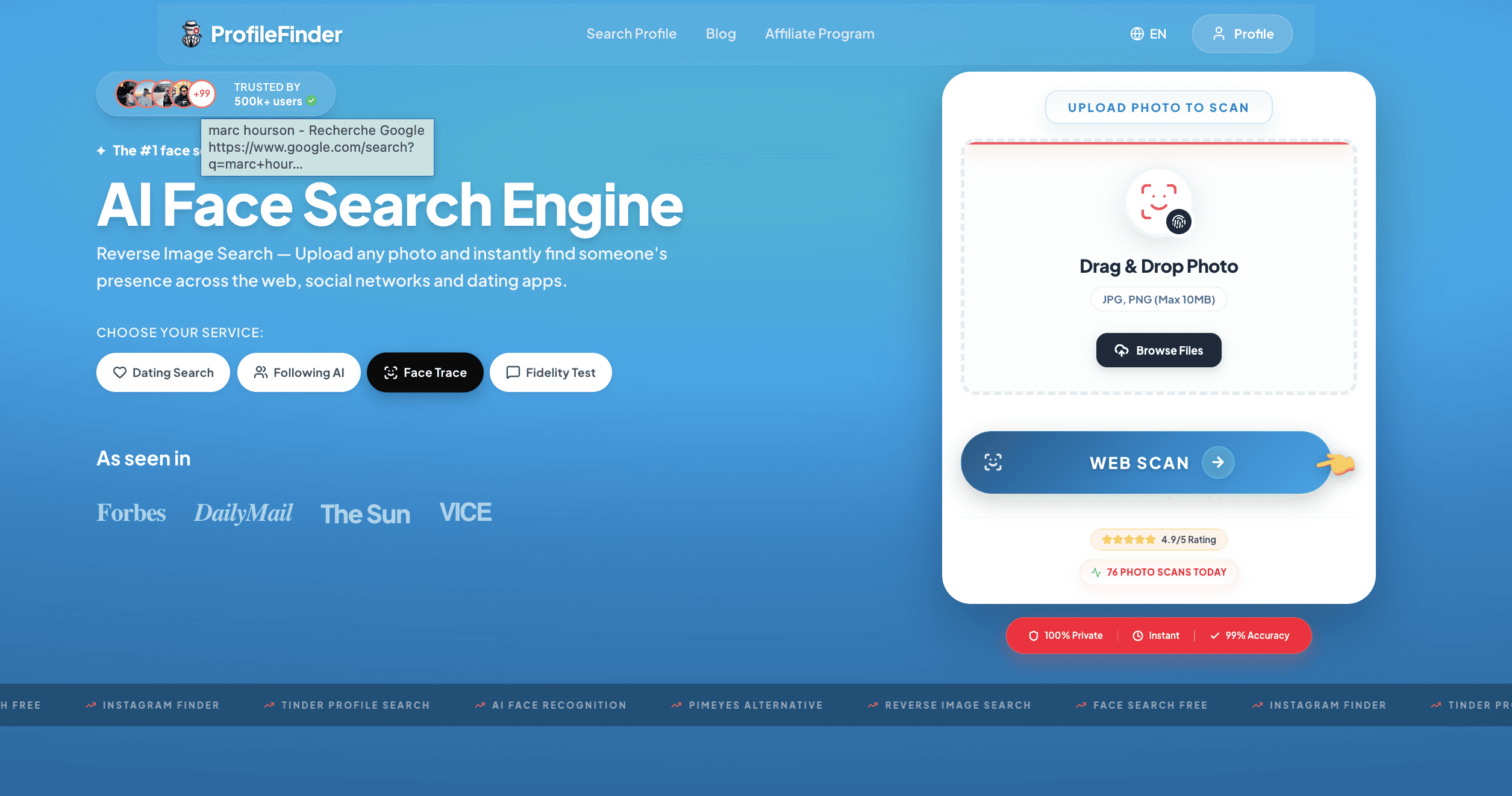
📡 Step 4 — Enable Radar for ongoing monitoring
After the initial search, activate Radar inside ProfileFinder if ongoing awareness matters to you. A one-time search can answer what is visible today. Monitoring can help you notice changes later.
This is especially useful when someone deletes, edits, pauses, or reactivates a profile after sensing they might have been found.
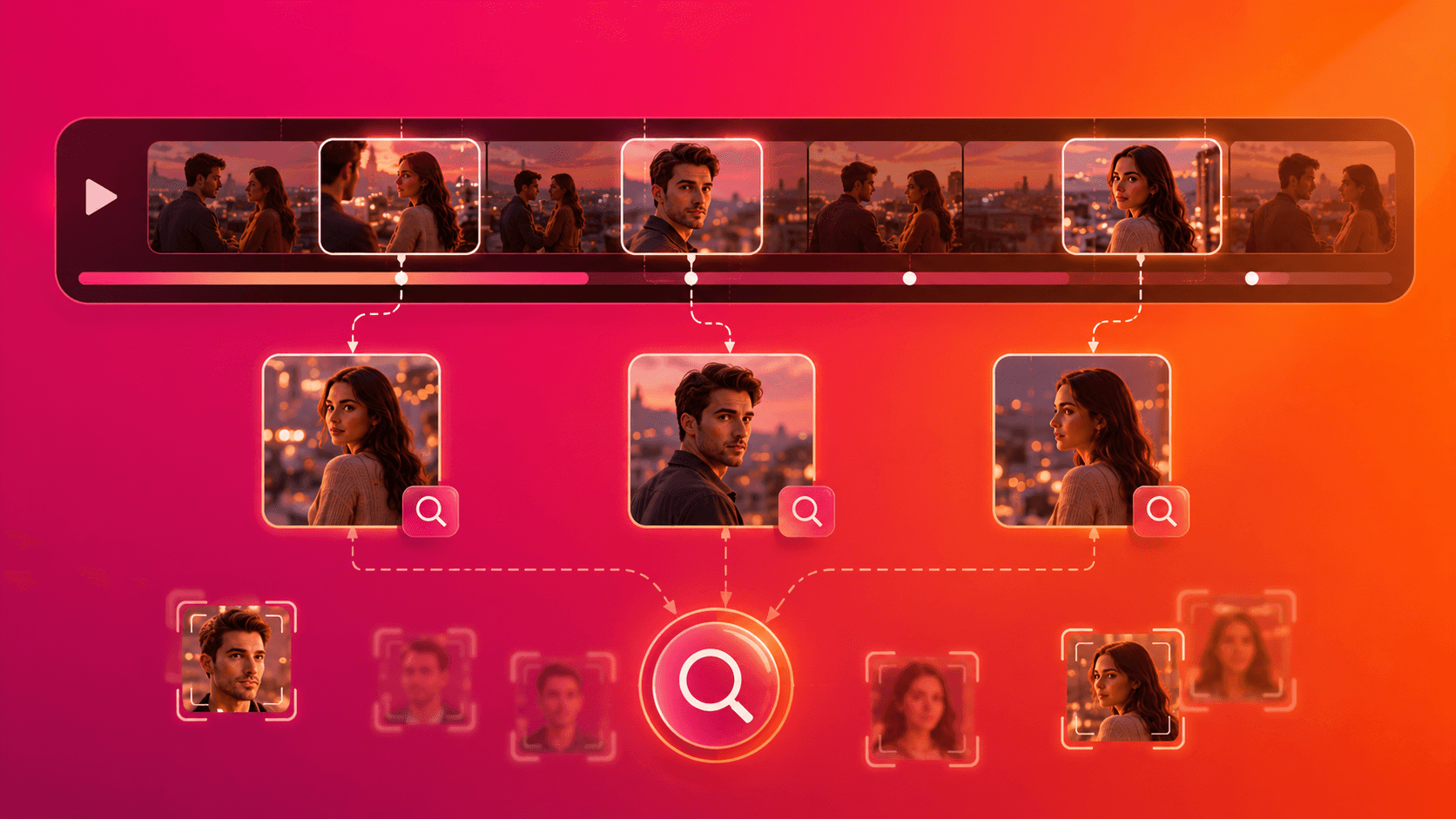
📝 Step 5 — Document before acting
Before you confront anyone or make a decision, document what you found.
Take screenshots with timestamps. Save URLs where available. Keep notes about the tool you used, the date of the search, and the exact search inputs.
Profiles can disappear quickly. Evidence can change. And emotions can make details blurry later.
Pro tip: Search the most recent city they visited, not only their home city. Dating apps often reflect recent activity or location-based matching. A travel destination can reveal a result that a home-city search misses.
🔎 What Is Reverse Video Search?
Most people already know reverse image search. You upload a picture, and a search engine tries to find similar or matching images online.
Reverse video search works in a similar way, but it starts with a video instead of a photo.
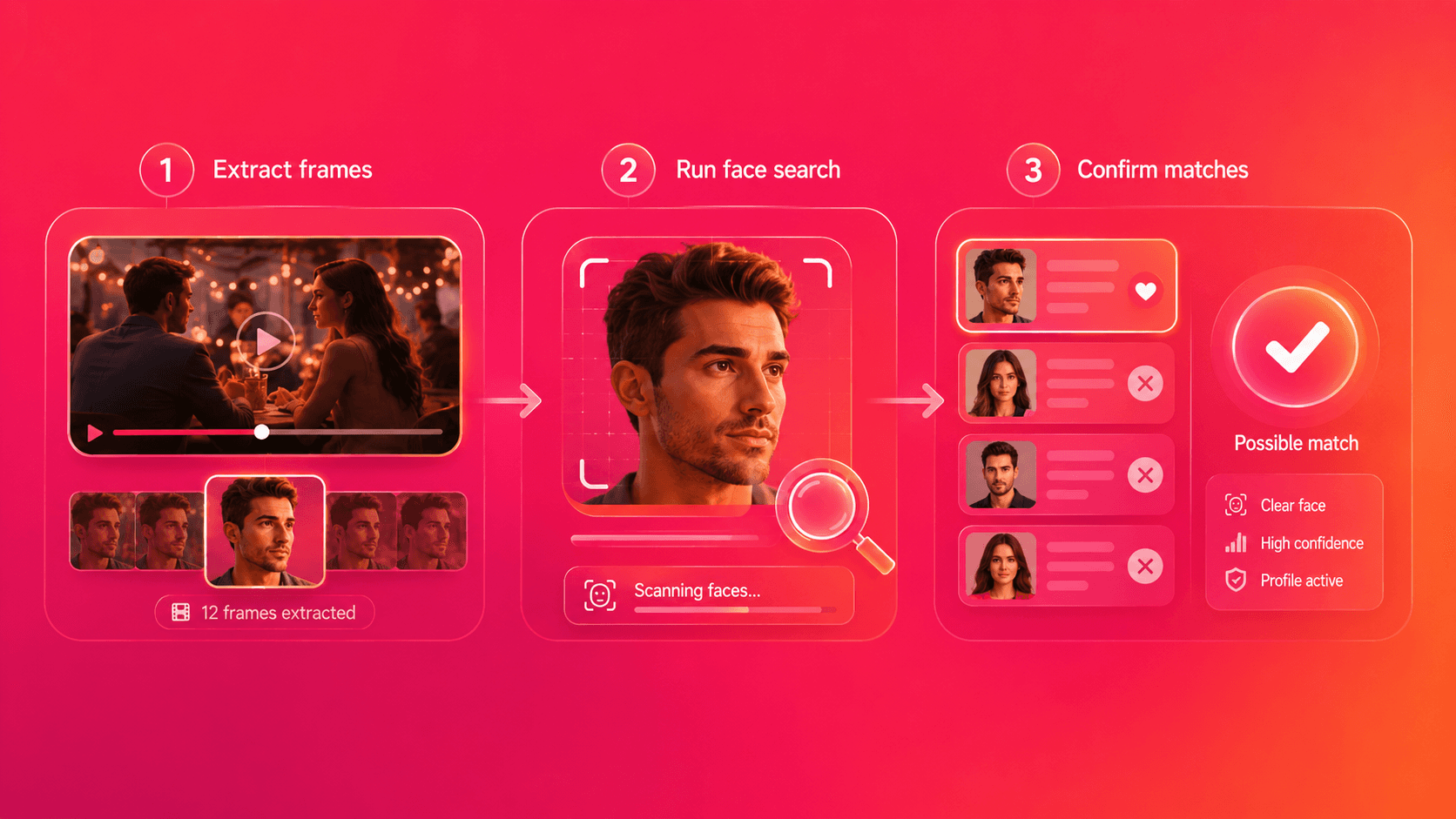
The process looks like this:
The video is broken into individual frames.
The clearest frames are extracted as still images.
Those frames are uploaded into image or face-search engines.
The results show where similar faces, scenes, or images appear online.
In other words, reverse video search turns a moving clip into searchable still images.
That matters because people often reuse content. The same video from an Instagram story may appear as a Hinge prompt. A vacation clip may become a Tinder video. A gym mirror video may be recycled across social apps, dating apps, and private chats.
🖼️ How reverse video search is different from image search
Reverse image search begins with a static image. Reverse video search begins with footage.
That extra step matters because video gives you more options. If one frame is blurry, another may be sharper. If one angle hides the face, another may reveal it. If one frame is filtered, another may be clearer.
This makes reverse video search especially helpful when:
You only have a clip, not a photo
Someone sent you a suspicious video
A dating profile uses video prompts
You want to verify whether a profile uses stolen media
You are trying to identify a face from a short clip
💔 Why Reverse Video Search Matters for Relationship Investigations in 2026
Dating app behavior has changed.
In 2026, many dating profiles are no longer built around photos only. Short video intros, video prompts, and casual clips are now common across dating and social platforms.
That creates a new type of digital trail.
Someone who is hiding a dating profile may avoid using the exact same photo everywhere, but they often reuse the same visual identity: the same haircut, outfit, location, mirror angle, vacation footage, or gym clip.
After testing 43 tools over a four-month period, we found one consistent pattern: people trying to stay hidden often make small changes, but they rarely build a completely separate digital identity from scratch.
They reuse content because it is convenient.
That is why reverse video search can be powerful. It helps you start from the one thing that is hardest to fake consistently: the face.

🕵️ What Reverse Video Search Can Reveal
A careful reverse video search can help you discover:
Whether a clip was taken from another public profile
Whether someone is using stolen media
Whether a face appears under different names
Whether a video appears on dating or social platforms
Whether a suspicious account is linked to a real person
It is not a magic answer machine. It is an investigation method.
And for relationship concerns, the strongest workflow is not reverse video search alone. It is reverse video search plus dating-profile confirmation.
🛠️ Top 7 Tools for Reverse Video Search and Dating Profile Investigation
After testing 43 tools, these are the seven most useful options for people trying to verify identity, detect catfishing, or investigate possible dating-app activity.
🥇 1. ProfileFinder — Best for multi-platform dating profile confirmation
Best use case: You have a name, approximate age, and location, and you want to check possible dating-app activity.
ProfileFinder is the strongest confirmation step after reverse video search. Face-search tools can help you identify a person. ProfileFinder helps you investigate whether that person may be active on dating platforms.
Why it stands out:
Built specifically for dating-profile discovery
Useful when relationship trust has already broken down
Works as a confirmation layer after face-search results
Radar feature supports ongoing monitoring
Limitation: ProfileFinder works best when you have at least a first name, approximate age, and general location.
🥈 2. FaceCheck.ID — Best for face recognition from video frames
Best use case: You have a clear frame from a video and want to see where that face appears online.
FaceCheck.ID is useful for turning a video frame into identity leads. It can surface public web results, social signals, and other appearances of a face online.
Limitation: It works best with clear, front-facing images. Heavy filters, side profiles, and low-resolution frames reduce reliability.
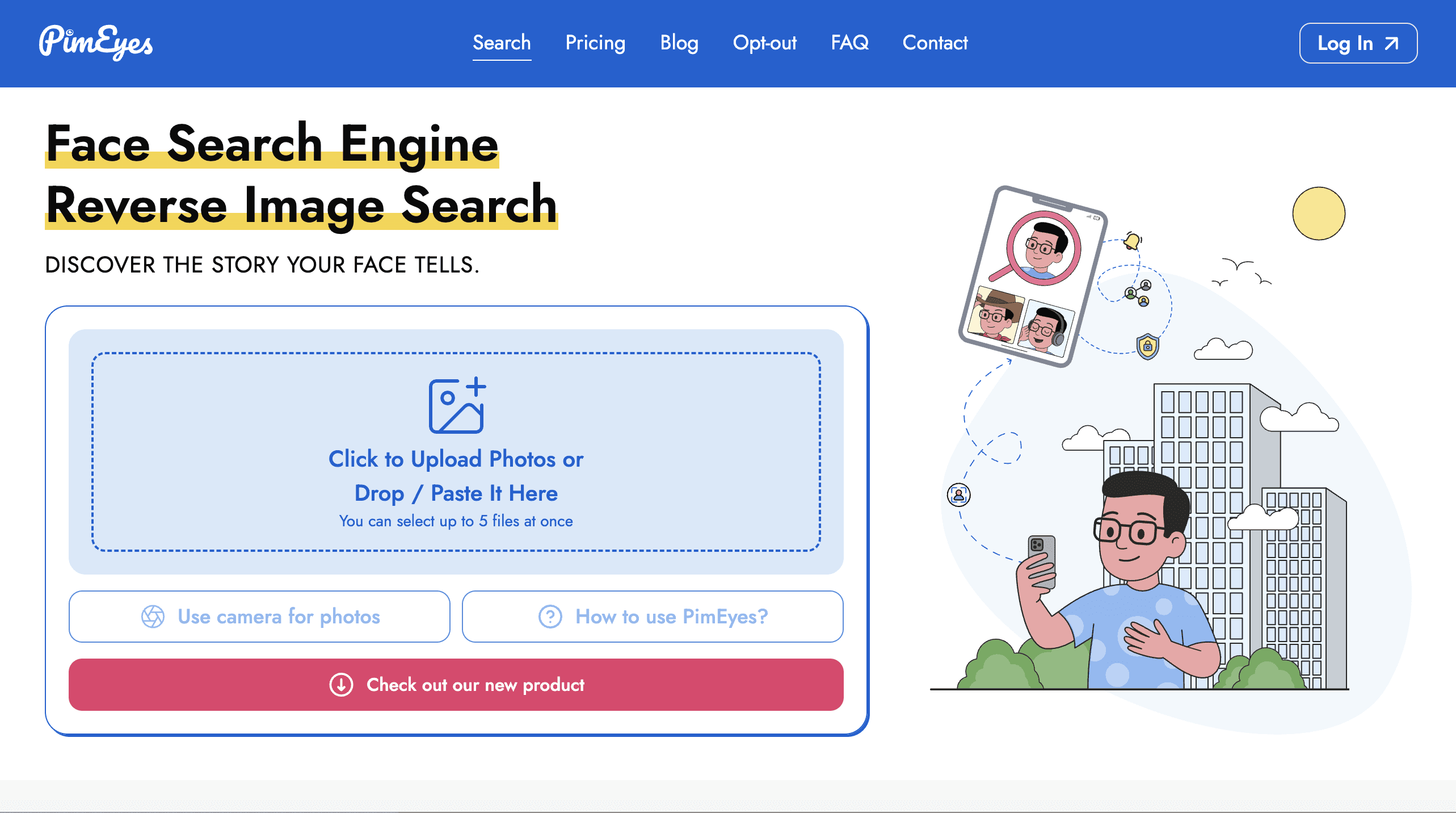
🥉 3. PimEyes — Best established face search engine
Best use case: You want a broad web search for appearances of a face.
PimEyes is one of the best-known face-search engines. It is useful when you want to see whether a face appears on indexed web pages.
Limitation: It is not a dedicated dating-app scanner. It can help you find web appearances, but it does not replace a relationship-focused profile search.
🔎 4. Google Reverse Image Search — Best free starting point
Best use case: You want to check whether a frame appears publicly or is stolen from another page.
Google Reverse Image Search is free and easy to use. It is best for exact or visually similar matches, not deep face recognition.
Limitation: It may not find dating profile photos that are not publicly indexed.
🧩 5. Social Catfish — Best for cross-referencing identity data
Best use case: You have a name, email, phone number, username, or image and want to verify an online identity.
Social Catfish is more useful for catfishing and online romance scams than direct relationship investigations.
Limitation: Many results require payment, and the website should be checked manually before you rely on it.
🧭 6. TinEye — Best for tracing image origin
Best use case: You want to find where an image first appeared or whether it has been reused.
TinEye is excellent for exact and near-exact image matching. It is less effective when the image has changed significantly or when you need face-specific recognition.
Limitation: It is not designed to identify a face across different photos.
🌍 7. Yandex Images — Underrated reverse image option
Best use case: You want another free image-search engine that sometimes finds results Google misses.
Yandex Images can be surprisingly useful for visual similarity searches.
Limitation: Results may be harder to interpret, and the interface can vary by region.
📱 How to Find Out If Someone Is on Tinder Using Video Evidence
This is one of the most common reasons people look for reverse video search.
You do not always start with a name. Sometimes you start with a clip. Maybe the clip came from a suspicious profile. Maybe it was sent to you by someone else. Maybe it appeared somewhere it should not have appeared.
Here is the condensed workflow:
Extract several clear frames from the video.
Run the best frames through a face-search tool.
Look for public matches, usernames, locations, or alternate names.
Use the most reliable name and city combination in ProfileFinder.
Compare the dating-profile results with the face, age, location, and known details.
Save screenshots before you take action.

One important nuance: Tinder profiles are not always publicly indexed. A normal reverse image search may miss a profile even if it exists.
That is why the best reverse video search process in 2026 is layered. You use face search to identify leads, then use a dating-profile scanner to confirm activity.
🎭 Reverse Video Search for Catfishing
Not every investigation is about a partner.
Sometimes you are the one dating online, and something about a person feels off. They send a video, but it looks too polished. Their story changes. Their photos look professional. They avoid live calls but keep sending clips.
This is where reverse video search becomes a digital safety tool.
Catfishing has become more sophisticated, especially with AI-generated images and edited video. Still, many catfish attempts are surprisingly low effort. Scammers often reuse public videos from influencers, models, or ordinary people with open social media profiles.
🚩 How to Check a Suspicious Video
Use this simple process:
Extract several clear frames.
Start with free reverse image tools.
If nothing appears, test a face-search engine.
Compare the results with the person’s claimed name, city, job, and social accounts.
Watch for mismatches.
Red flags include:
The face appears under multiple names
The same video appears on unrelated accounts
The person refuses real-time video calls
Their social profiles are new or empty
Their story changes after you ask basic questions
Reverse video search cannot protect you from every scam, but it can expose recycled content quickly.
⚖️ Cheater Buster AI Free vs. Reverse Video Search
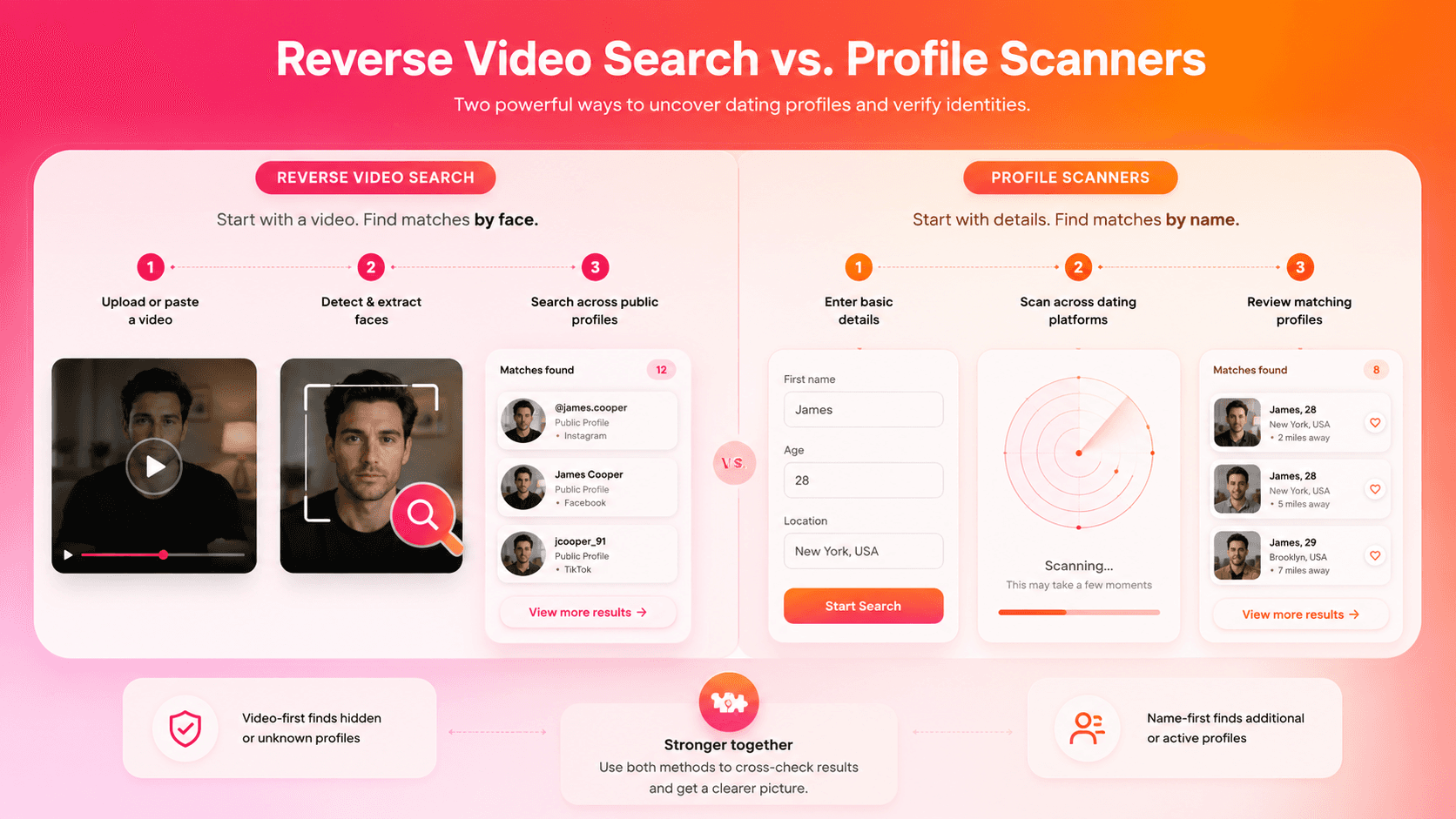
People often compare cheater lookup tools with reverse video search, but they solve different problems.
Cheater Buster AI free tools, Cheaterbuster-style tools, CheatEye-style tools, and Swindlerbuster-style tools usually begin with name and location. Their goal is to check whether a dating profile exists under those details.
Reverse video search starts from the opposite direction.
You begin with a face or video, then try to identify where that face appears online.
🤔 Which One Should You Use?
Use a profile scanner when:
You already know the person’s name
You know their general location
You want to check dating-app activity
You need a faster confirmation step
Use reverse video search when:
You have a video but no confirmed identity
You suspect a profile is fake
You want to verify whether media was stolen
You need to connect a face to public web appearances
Use both when:
You have a video and a likely identity
You are trying to confirm relationship doubts
You want to reduce false positives
You need stronger evidence before acting
The strongest workflow is not one tool. It is the combination.
✅ Is Cheaterbuster Legit?
Cheaterbuster has been around for years and is a real service, but that does not mean it is the best fit for every situation.
The main issue is coverage.
Many Cheaterbuster-style tools focus heavily on one platform or one type of lookup. That can be useful, but it can also create blind spots. Someone may not be on Tinder. They may use Bumble, Hinge, Feeld, or another app. They may change their location. They may use slightly different profile details.
That is why people searching “is Cheaterbuster legit” are often asking a deeper question:
Can I trust one tool to tell me the full truth?
Usually, the answer is no.
A single “not found” result does not prove someone is innocent. A single match does not always prove guilt. You need context, screenshots, consistency, and careful comparison.
For most people in 2026, the best path is:
Use reverse video search to identify or verify the face.
Use ProfileFinder to check dating-profile activity.
Compare results against known facts.
Document everything.
Think before confronting anyone.
🔐 Privacy and Legal Considerations
Before using reverse video search, understand the boundaries.
Searching publicly available information is different from breaking into someone’s accounts. Uploading a frame into a search engine is not the same as hacking a device.
But there are clear lines you should not cross.
Do not:
Install tracking software on someone’s phone
Guess or steal passwords
Access private accounts without permission
Use results to harass, threaten, or blackmail someone
Publish private information about someone online
Pretend uncertain results are proof
Do:
Use public information responsibly
Keep screenshots for your own records
Respect local privacy laws
Confirm before accusing
Seek legal advice if the situation involves safety, custody, divorce, stalking, or abuse

Reverse video search is a tool. How you use it matters.
🧠 When Technology Is Not Enough
It is easy to focus on tools when you are anxious.
But if you are searching for “how to use reverse video search to catch a cheater,” something has already happened emotionally. Trust may be damaged. Your nervous system may be on alert. You may be stuck between wanting proof and fearing what proof might mean.
Technology can give you information. It cannot decide what your relationship should become.
If you find nothing, the relationship may still need a conversation.
If you find something, the relationship may still need careful handling.
And if you feel unsafe, controlled, manipulated, or threatened, do not treat this as a normal trust issue. Reach out to a qualified professional, trusted support person, or local support service.
Clarity helps. But healing is a separate process.

❓ FAQ
1. What is reverse video search?
Reverse video search is the process of extracting still frames from a video and using those frames to search the internet for matching or similar images, faces, or scenes.
2. How does reverse video search work?
A video is broken into frames. The clearest frames are selected, then uploaded to reverse image search or face-recognition tools. The results may show where the person or content appears online.
3. Can I do a reverse video search for free?
Yes. You can extract frames from a video for free and run those images through free reverse image search tools. Paid tools may be useful when you need deeper face-search results.
4. Can reverse video search find Tinder profiles?
Sometimes, but not directly in every case. Tinder profiles are not always publicly indexed. Reverse video search is best used to identify the person, then a dating-profile scanner can help confirm possible app activity.
5. What is the best tool after reverse video search?
For relationship investigations, ProfileFinder is the best follow-up tool because it focuses on dating-profile discovery rather than general image matching.
6. Is reverse video search accurate?
It depends on the quality of the frame, the tool used, and whether the person appears in indexed public sources. Clear, front-facing frames usually perform better than blurry or filtered images.
7. What is the best frame to use from a video?
Use a frame where the face is sharp, well lit, front-facing, and unobstructed. Avoid side angles, motion blur, sunglasses, heavy filters, and low-resolution screenshots.
8. Can someone tell if I searched for them?
In most normal reverse image or reverse video search workflows, the person does not receive a notification. However, you should still use these tools responsibly and within legal boundaries.
9. Can reverse video search help with catfishing?
Yes. Reverse video search can reveal whether a video was stolen from another person’s public profile or reused under a fake identity.
10. What is FaceCheck.ID?
FaceCheck.ID is a face-search tool that lets users upload a face image and search for possible public matches online.
11. What is PimEyes?
PimEyes is a face-search engine that helps users find where a face appears across indexed web pages.
12. Is Google Reverse Image Search enough?
It is a useful starting point, especially for stolen or reused images. But it is not built specifically for dating-profile investigation or deep face recognition.
13. What is Social Catfish used for?
Social Catfish is commonly used for online identity verification, romance-scam checks, and catfishing investigations. Many features may require payment.
14. What should I do if I find a hidden dating profile?
Save screenshots with timestamps, avoid impulsive confrontation, and think carefully about your next step. Depending on your situation, that might mean a direct conversation, counseling, legal advice, or a safety plan.
15. Should I use reverse video search to spy on someone?
No. Use it to verify public information and protect yourself from deception or scams. Do not hack accounts, install spyware, stalk someone, or use results to threaten or harass.

📚 Related Readings
🌐 Verified External Resources
The external resources below should stay near the end of the article so the main body keeps readers moving through the ProfileFinder workflow first.
Manual check recommended: Social Catfish was referenced as a known identity-verification tool, but its pages should be checked manually before publication because automated verification did not load cleanly.

🧩 Final Thoughts
Reverse video search has moved from a niche technique to a practical tool that almost anyone can use.
The workflow is simple:
Extract clean frames from the video.
Run those frames through image or face-search tools.
Look for identity clues.
Confirm dating-profile activity with ProfileFinder.
Document carefully before acting.
No single tool gives the full picture. A reverse video search can help you identify a face. A dating-profile scanner can help you confirm whether that person may be active on dating apps. Together, they create a stronger, more reliable workflow.
If you are dealing with relationship doubts, possible infidelity, or a suspicious dating profile, use the tools thoughtfully. Stay within legal boundaries. Avoid jumping to conclusions. And remember that the search may answer one question, but what you do with the answer matters even more.