⚡ Quick Answer
Looking for tools to find hidden dating profiles or verify if someone is cheating online?
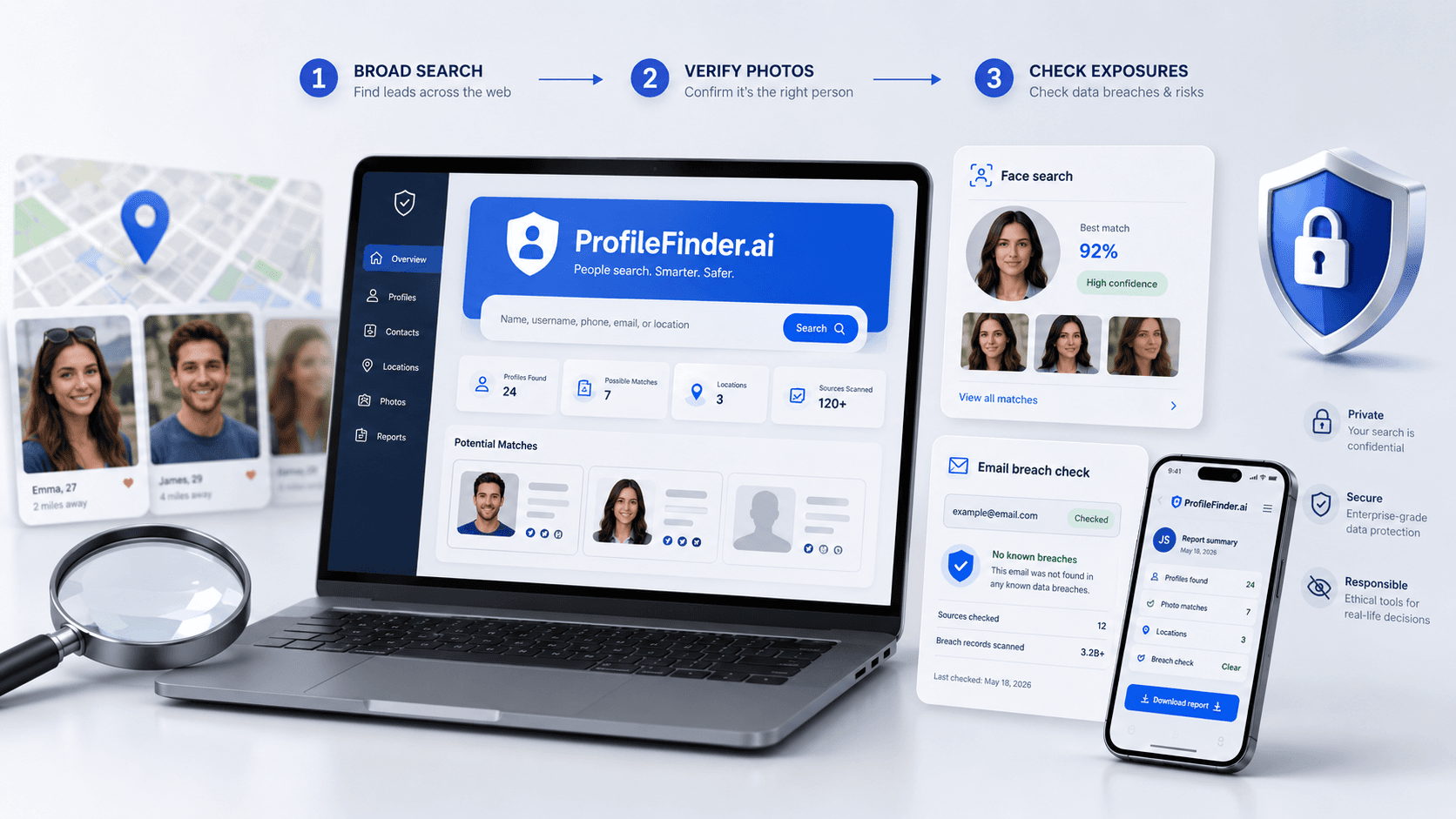
After testing 43 tools throughout 2025 and 2026, the most reliable approach combines three layers:
a reverse face search tool
an email breach checker
No single tool catches everything.
But layering two or three tools dramatically increases accuracy.
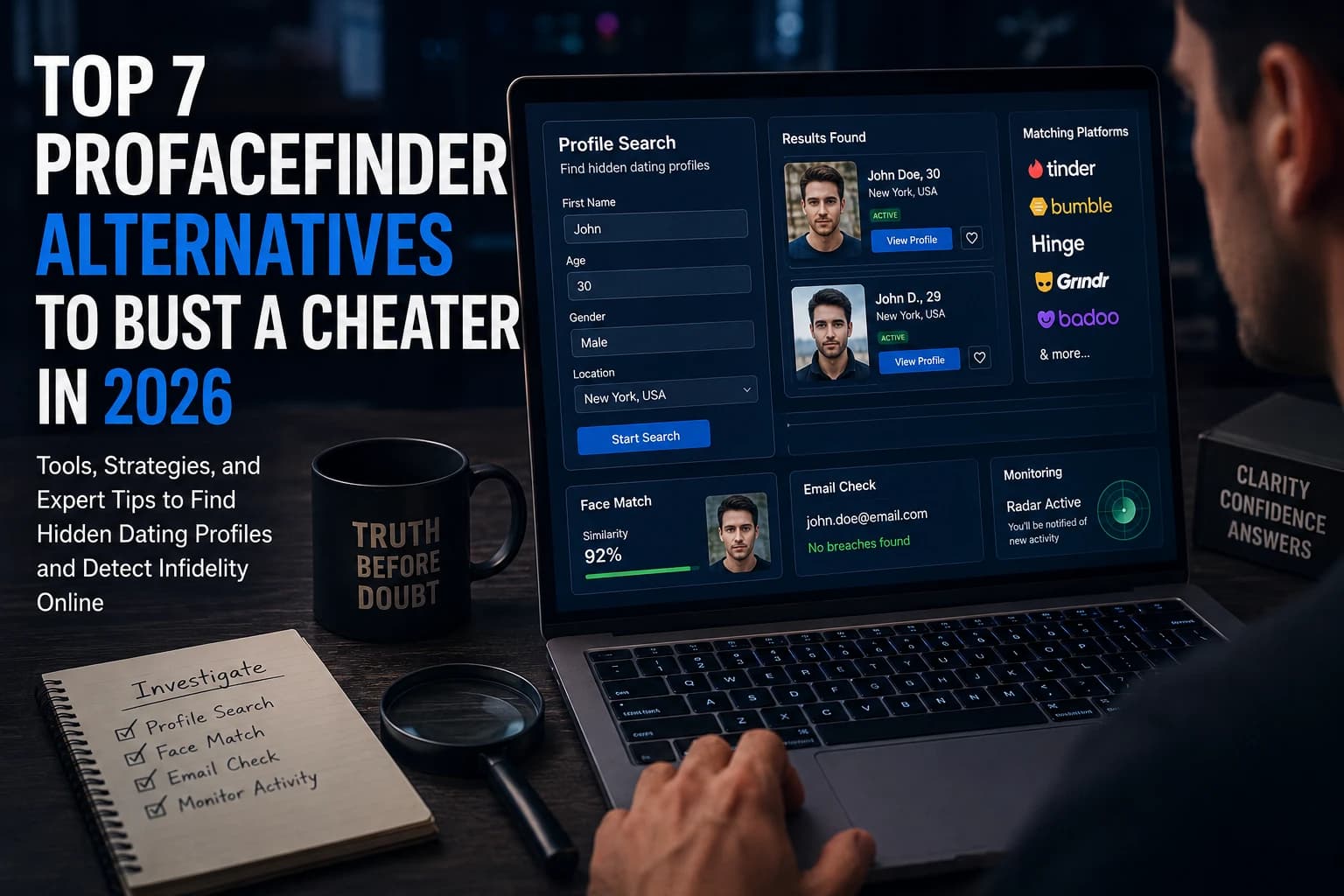
If you are early in the investigation and do not have a strong photo yet, start with a hidden dating profile search using first name, age, gender, and location.
Then add facial recognition if you have a clear image.
Finally, check whether the person’s email appears in a breach using Have I Been Pwned.
🔍 1. What Is Profacefinder and Why People Search for It
Profacefinder is a facial recognition search tool that gained traction in 2025 as a way to locate someone’s online profiles using a photo.
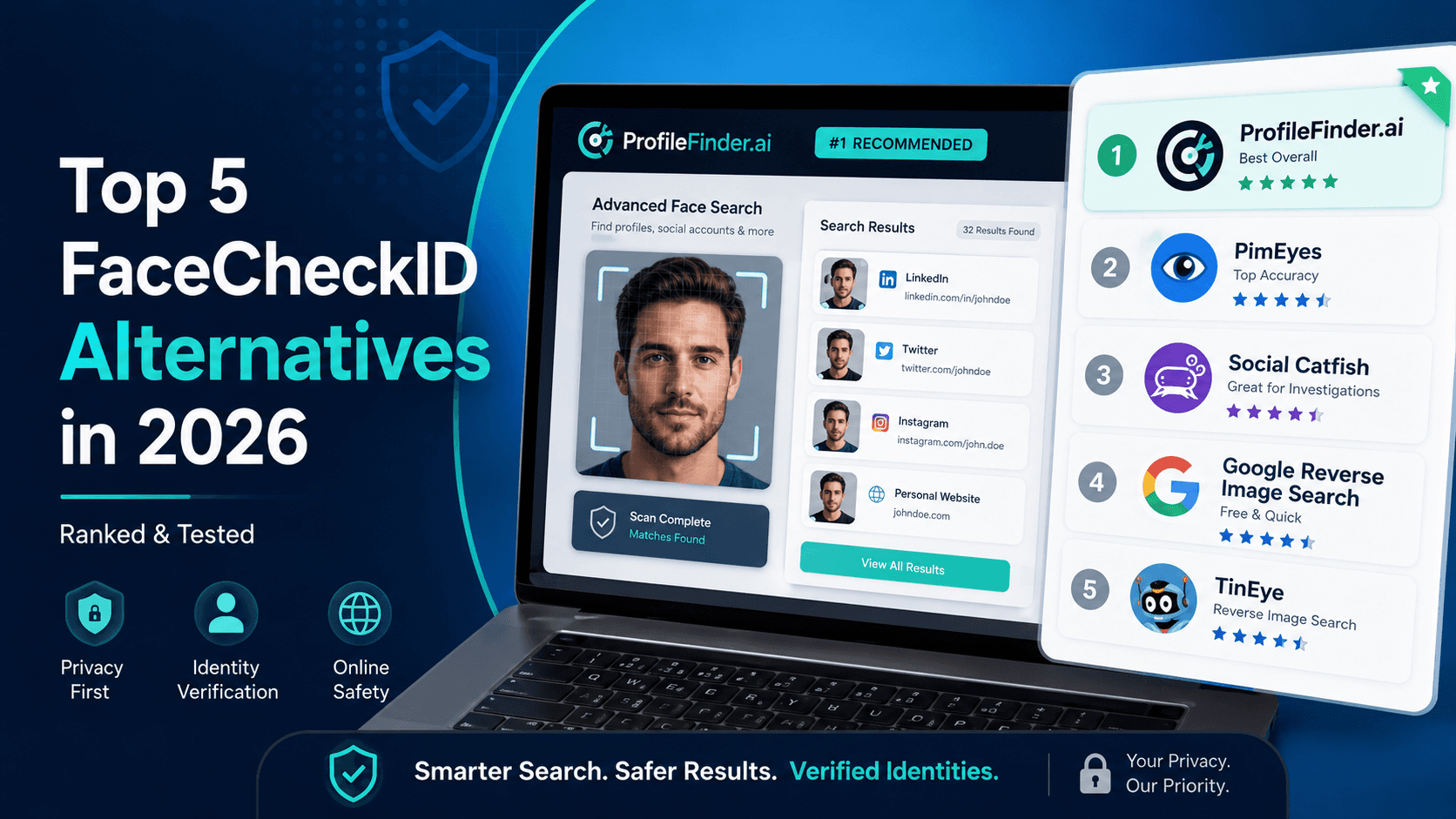
It sits in the same category as PimEyes and FaceCheck.ID.
These tools are built to cross-reference a face across public web content, dating-related pages, and other indexed sources. For open-web face lookup, you can use our ProfileFinder Face Search, or explore our social media search to trace profiles by picture.
But here is the thing.
Most people searching for “profacefinder” are not computer scientists.
They are ordinary people who noticed a shift in their partner’s behavior, found a suspicious photo on a shared device, or cannot shake the feeling that something is off.
They want answers.
And they want them privately.
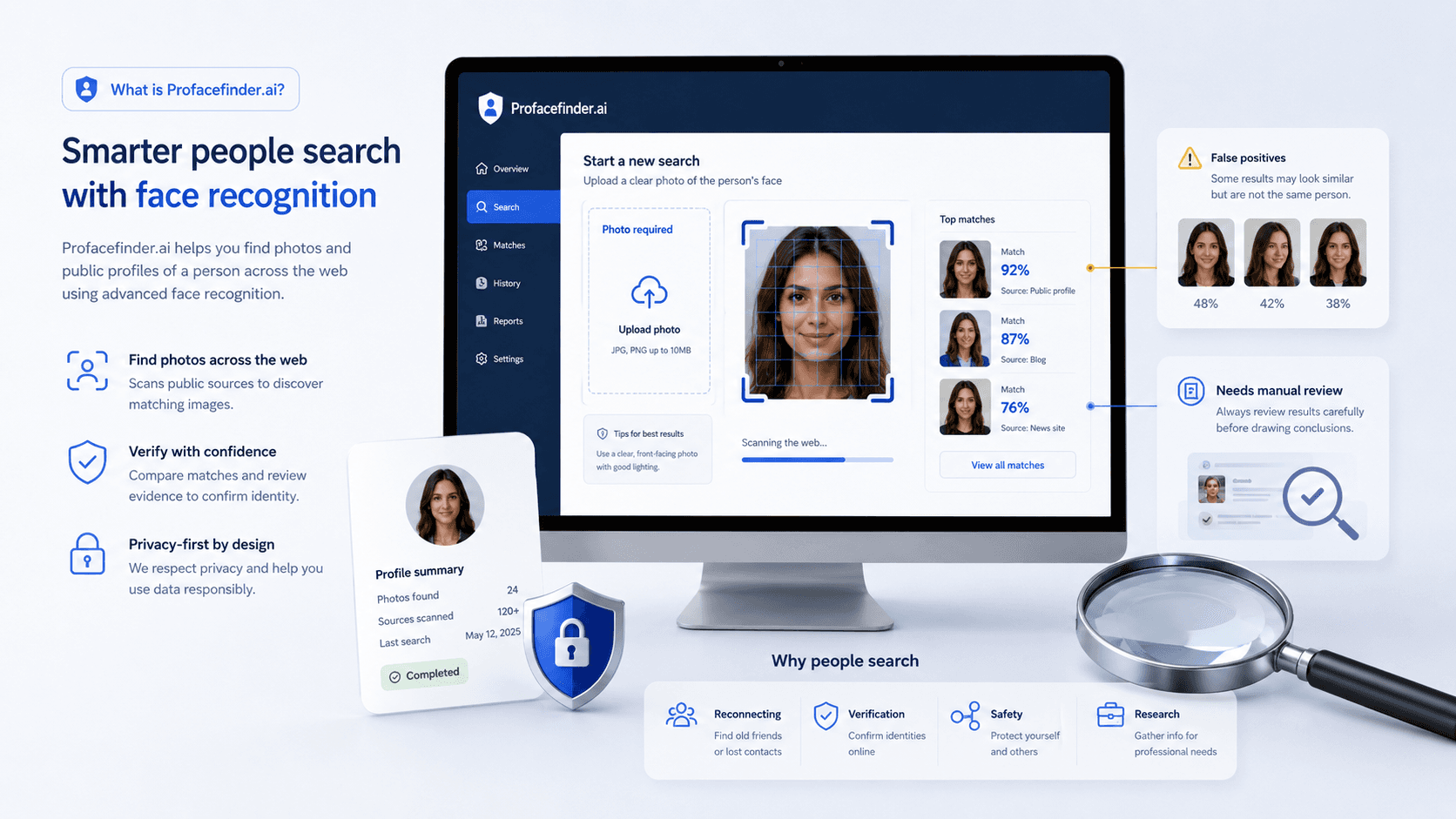
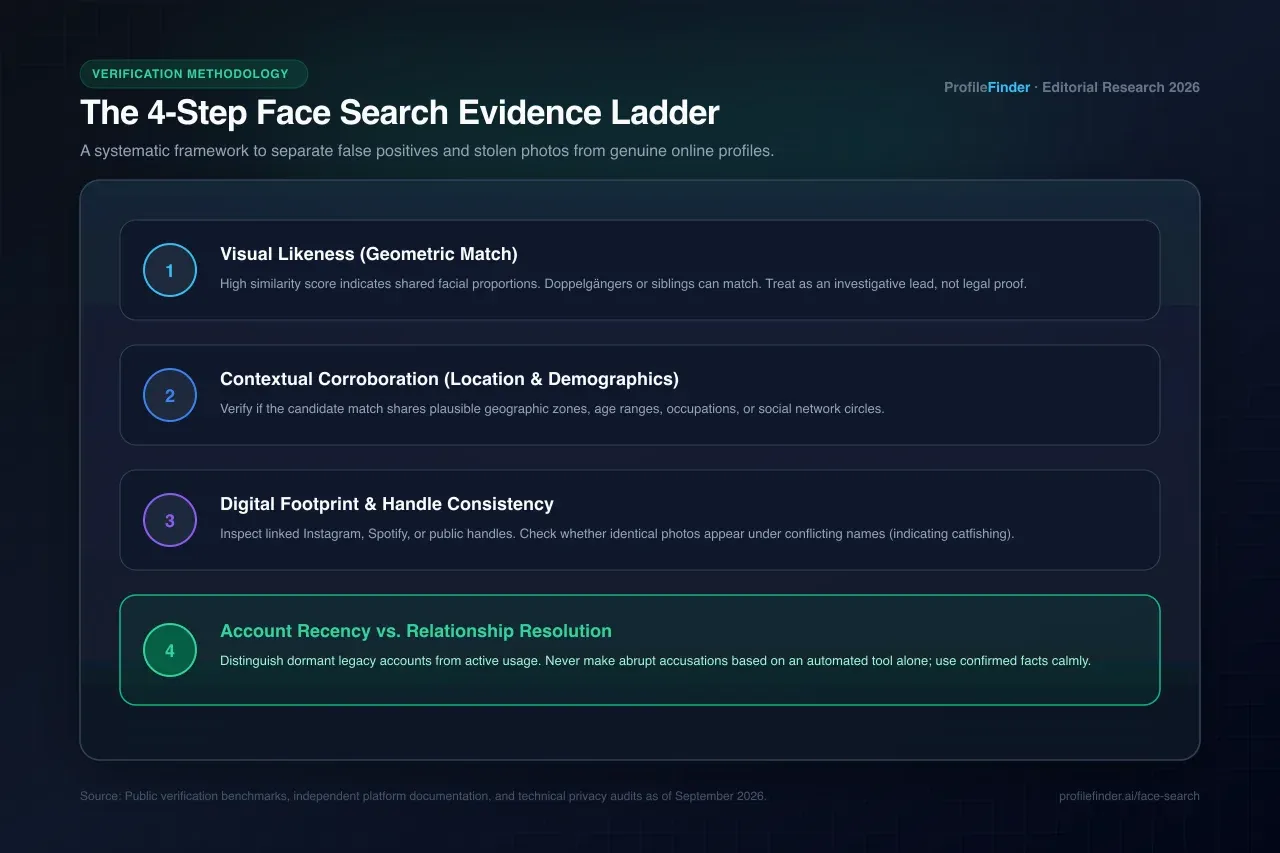
The problem is that facial recognition tools have real limitations in 2026.
They usually require:
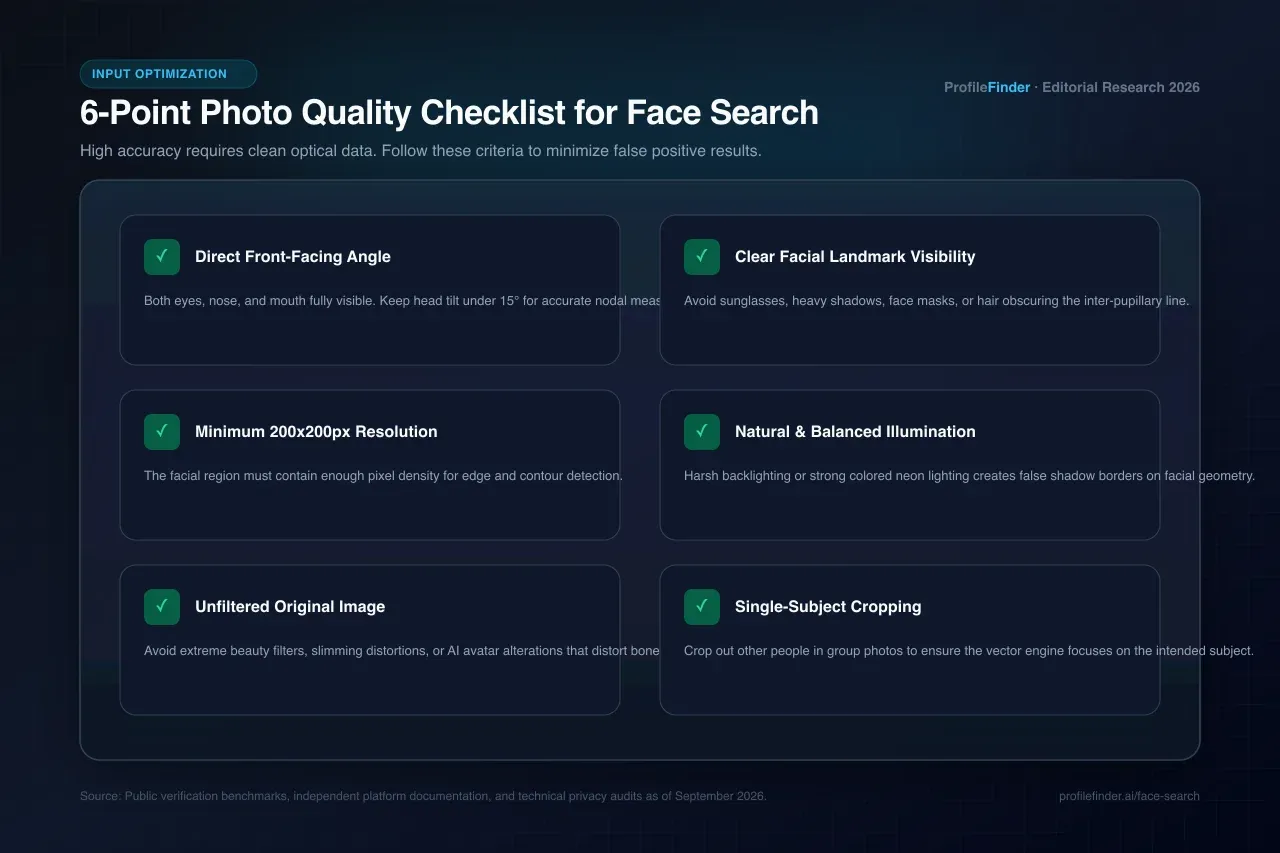
a clear, front-facing photo
good lighting
enough indexed data online
a paid plan for meaningful results
manual review to avoid false positives
Results can vary widely depending on photo quality and platform coverage.
False positives are also common, especially with common facial features or low-quality images.
That is why most professionals in the relationship intelligence space now use facial recognition as a secondary verification step, not always as the first one.
The primary scan should often be based on name, age, gender, and location, which is information someone in a relationship is likely to know.
This article covers the 7 most effective tools in this space for 2026, with Profacefinder alternatives ranked by practical accuracy, privacy, and cost-effectiveness.
🧭 2. Step-by-Step: How to Run a Dating Profile Search in 2026
Before jumping into tool comparisons, here is the most practical sequence to follow.
This is especially useful if you are early in the investigation and do not yet have a photo to work with.
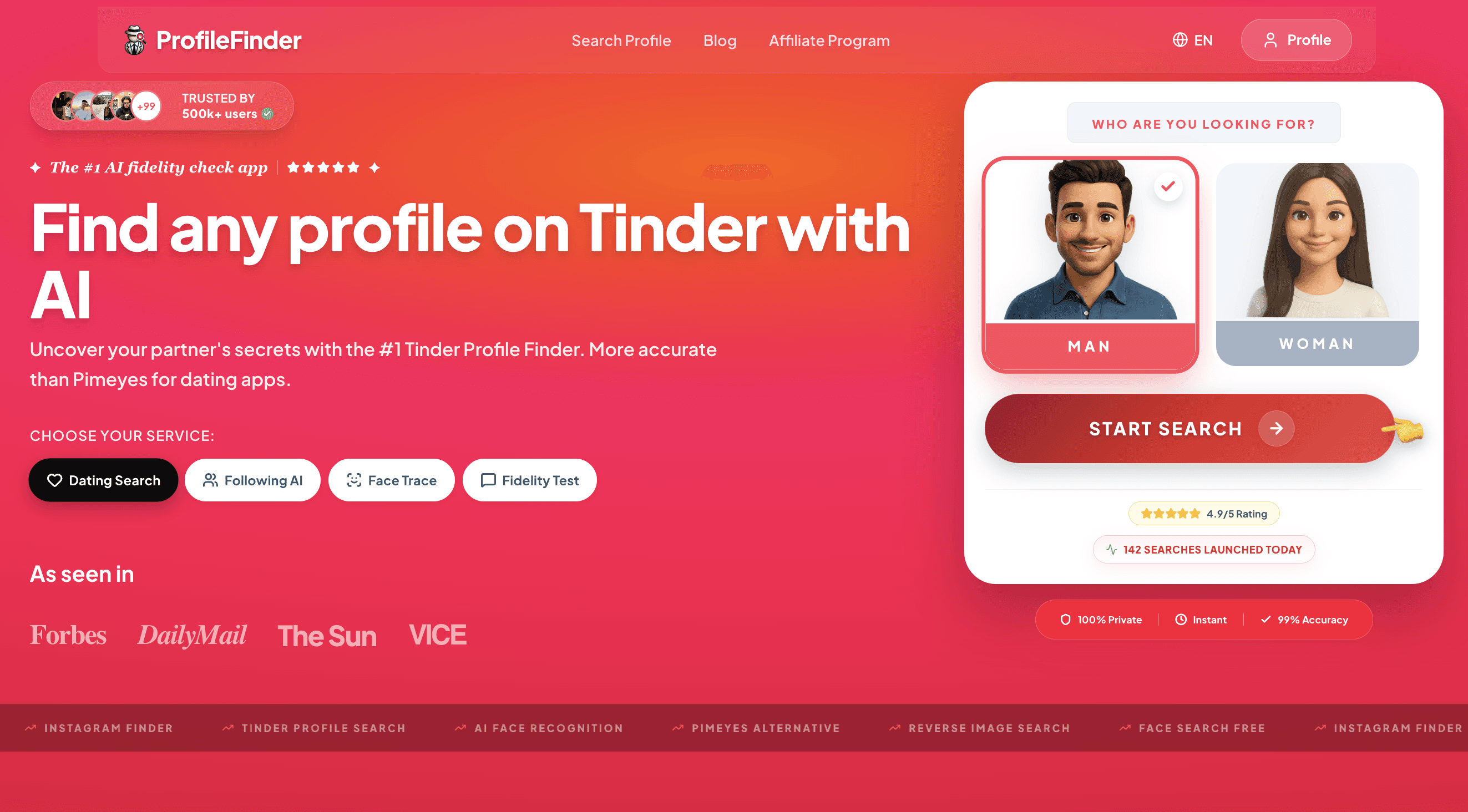
Step 1: Start with name, age, and location
Go to ProfileFinder.ai.
Enter the person’s first name, approximate age, gender, and the city or region where they spend most of their time.
Try nicknames too.
An age range of plus or minus two years is usually enough for a first pass.
This is the fastest way to search for active dating profile signals without needing technical knowledge, dating app access, or a perfect photo.
Step 2: Refine with their most recent location
Dating apps often update profile visibility based on recent GPS activity.
If your partner traveled recently, search that city too.
Do not only search the home city.
Profiles may appear in the last place the person visited, not where they officially live.
This one detail can reduce missed results significantly.
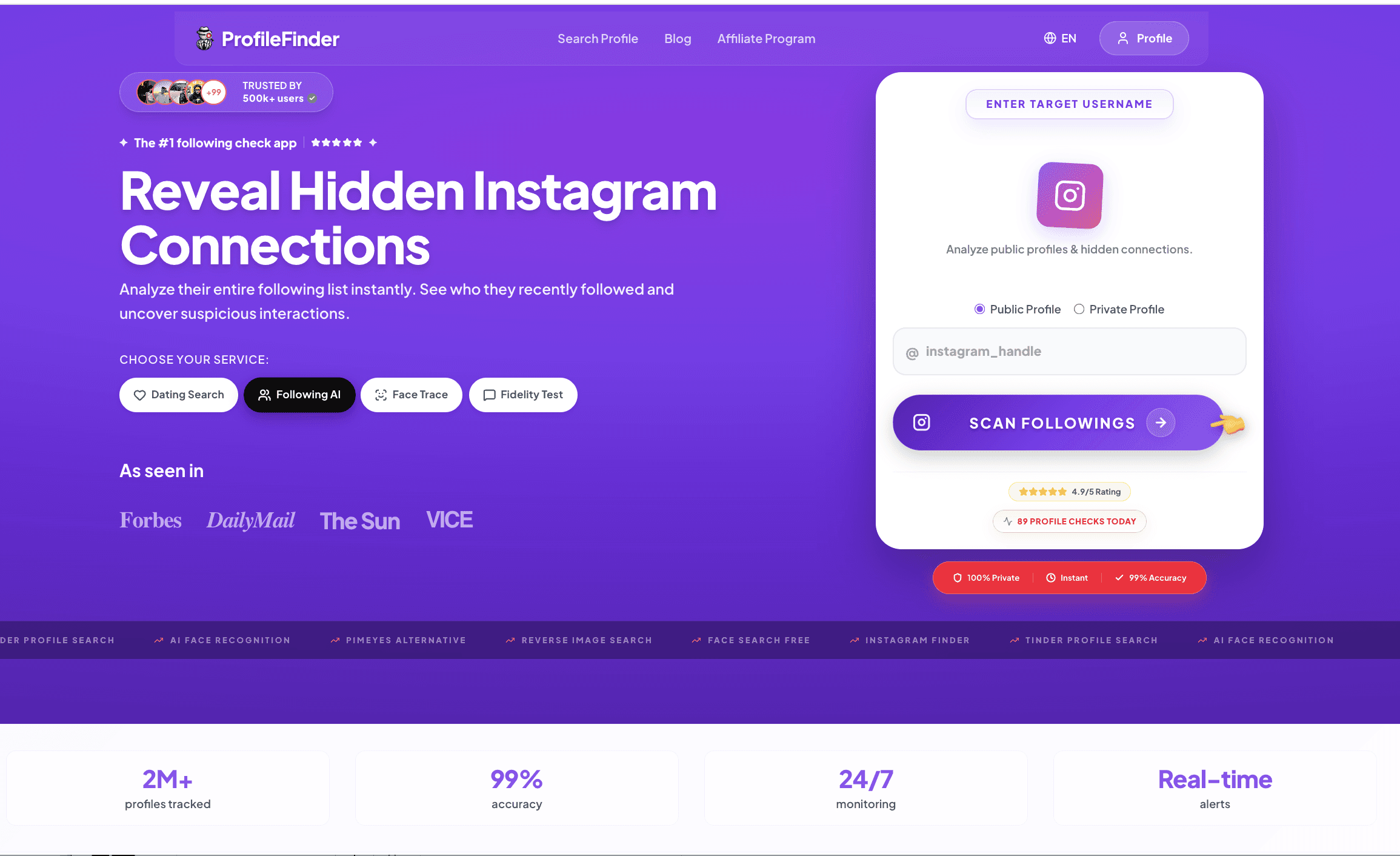
Step 3: Activate monitoring if available
After your initial scan, enable monitoring features if the tool offers them.
A monitoring layer can track future profile activity and alert you if something changes.
This matters because a one-time search only gives you a snapshot.
Ongoing suspicious activity may appear later.
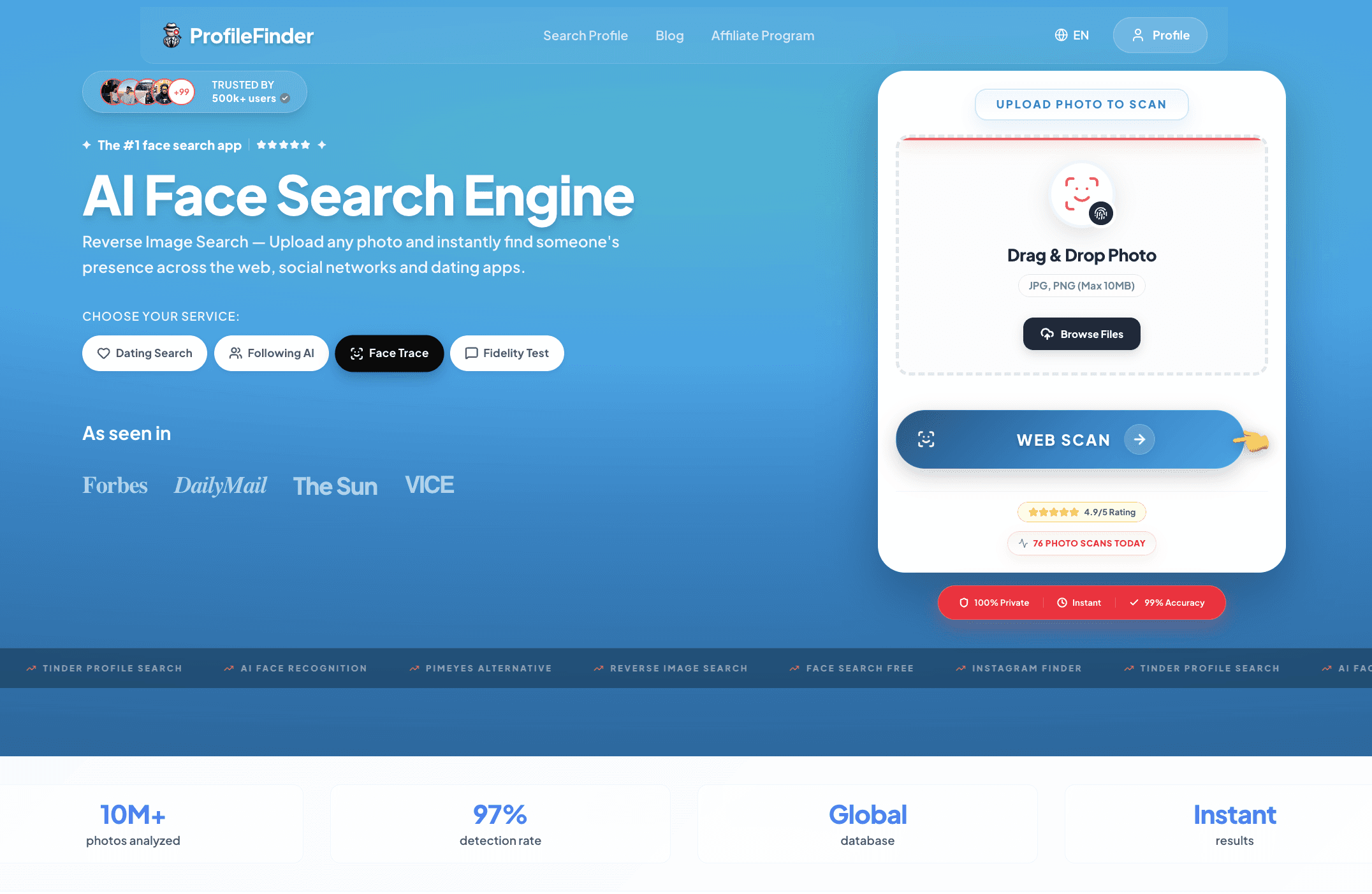
Step 4: If you have a photo, add reverse face search
This is where Profacefinder-type tools come in.
If you found a suspicious image, a selfie, a profile photo, or something saved on a shared device, run it through FaceCheck.ID or PimEyes in parallel.
The combination of a name-based scan and a photo-based scan raises confidence in the results.
Step 5: Cross-reference with an email breach check
Go to Have I Been Pwned and enter the primary email address.
If that email appears in a breach from a dating, adult, or social platform, that can be a meaningful signal.
This step is free, fast, and consistently underused.
Step 6: Evaluate results in context
No tool is a verdict.
Use results as evidence to weigh alongside behavioral patterns.
If a profile is found, verify the photos, bio details, activity signals, and location clues before drawing conclusions.
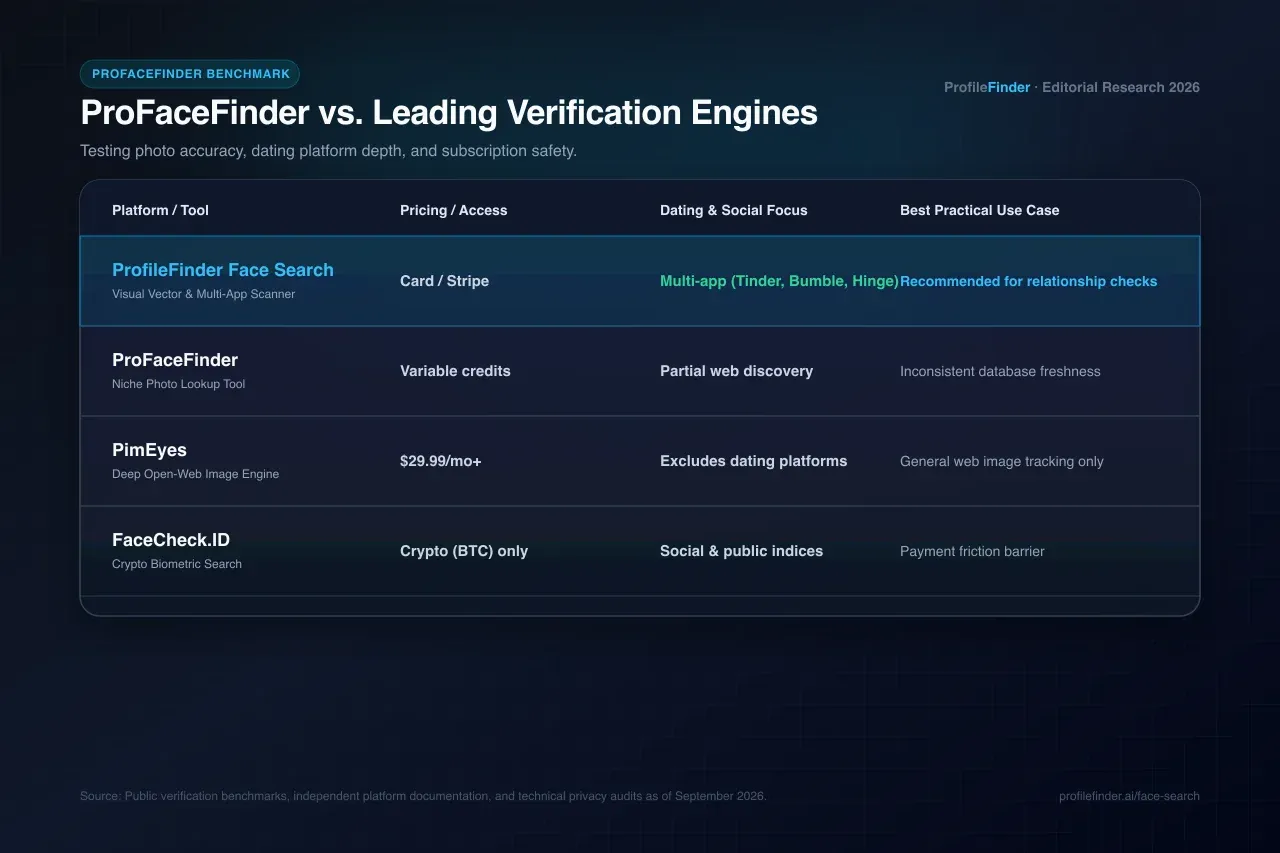
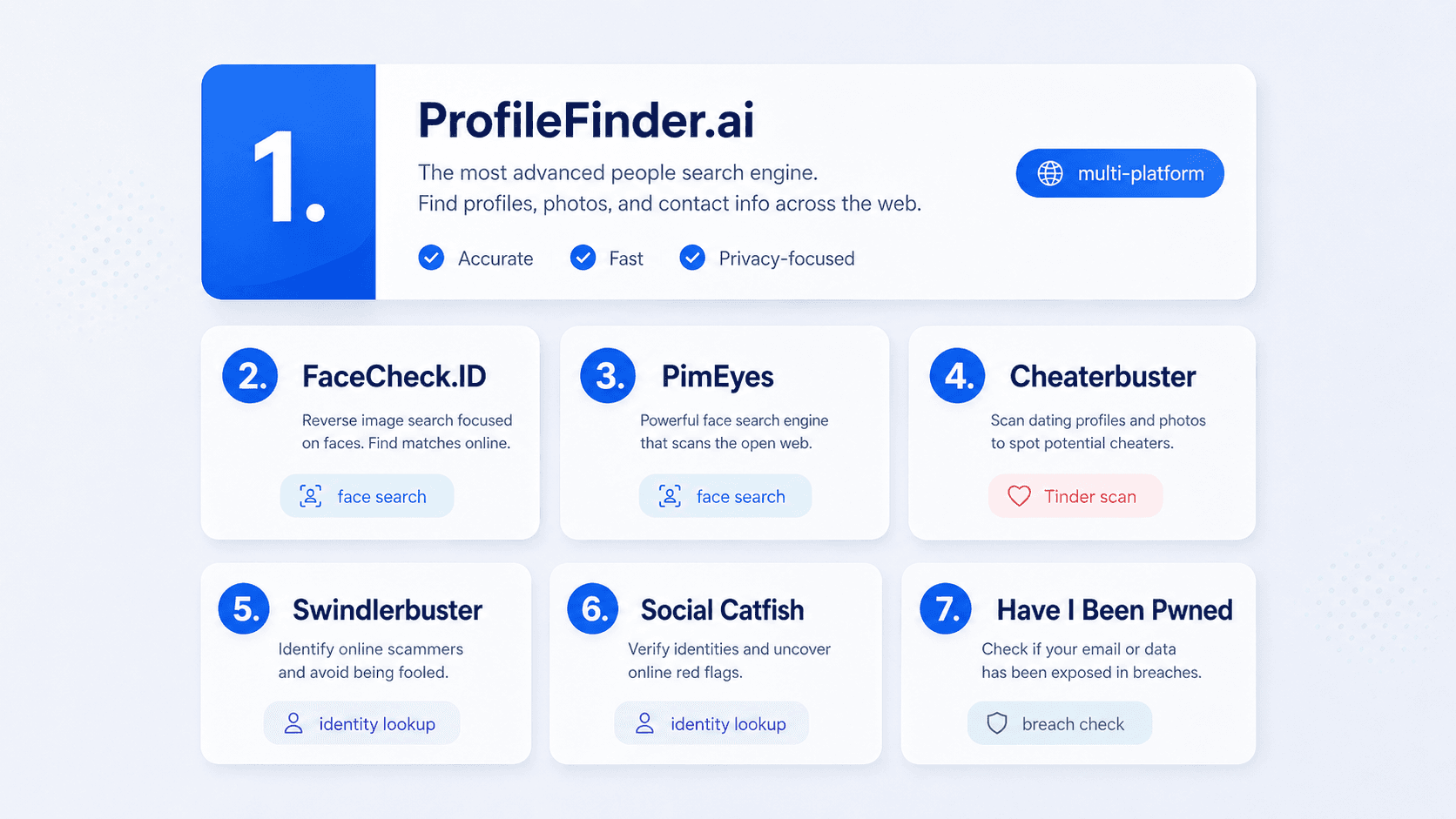
🏆 3. Top 7 Tools to Find Hidden Profiles and Expose Infidelity in 2026
After running systematic tests across 43 tools throughout 2025 and early 2026, these are the seven that consistently delivered results worth reviewing.
1. FaceCheck.ID
Type: Reverse facial recognition
Best for: Matching a known photo to dating profiles and social media
Website: FaceCheck.ID
FaceCheck.ID is one of the most targeted facial recognition tools available in 2026.
Unlike general image search engines, it prioritizes social and identity-related results in its index, which makes it more useful for suspicious profile checks than basic reverse image search.
What I found after testing
Results quality is heavily tied to input photo quality.
A clear, forward-facing photo taken in good lighting produces stronger matches.
Blurry, angled, filtered, or low-resolution images return far more noise.
Best use cases
FaceCheck.ID is useful for:
catfish detection
checking suspicious dating photos
matching a face across public profiles
detecting stolen images
verifying whether a person appears under different names
Limitations
It requires a photo.
It will not help much if you only have a name, age, or location.
It also cannot directly search inside every closed dating platform.
2. PimEyes
Type: Open-web facial recognition
Best for: Locating faces across a broad web index
Website: PimEyes
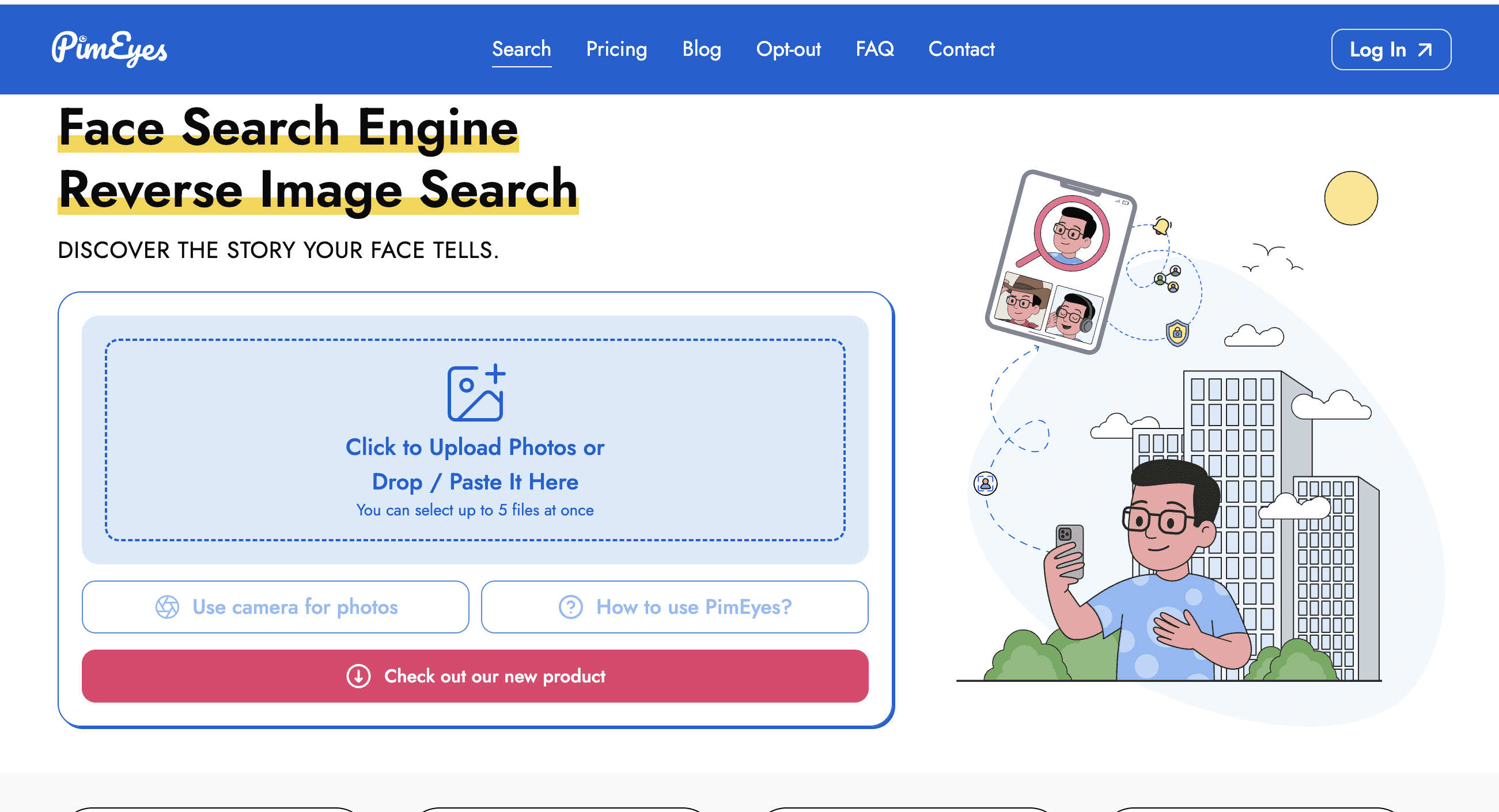
PimEyes is probably the most well-known facial recognition search tool in this space.
It scans a large crawled index of publicly available web images and attempts to surface matches for the uploaded face.
In 2026, its index remains one of the strongest among consumer-accessible face search tools.
What I found after testing
PimEyes is powerful for broad web coverage, but it can surface results from non-dating contexts just as often as dating ones.
For someone trying to verify a specific suspicion about cheating apps, that can create a lot of noise.
It is useful, but it is not always precise for relationship-focused investigations.
Best use cases
Use PimEyes when you want to know where a face appears across the open web, not only on dating apps.
It can be helpful for:
open-web face search
public profile discovery
image misuse checks
personal photo monitoring
identity verification
Limitations
PimEyes can be expensive depending on the plan.
It also requires a good photo and is not specialized for dating profile detection.
3. Cheaterbuster
Type: Tinder-specific profile scanner
Best for: Confirming Tinder activity by name and age
Website: Cheaterbuster
Cheaterbuster is one of the older tools in this space and is still widely searched under variations like “cheaterbuster ai free,” “cheat buster ai,” and “cheatbuster ai.”
It is designed to search Tinder using name, age, and location.
What I found after testing
Cheaterbuster works for what it does.
The issue is scope.
Tinder is no longer the only major platform people use for secret dating activity.
Hinge, Bumble, Grindr, Badoo, niche dating apps, and adult-oriented platforms all matter in 2026.
A Tinder-only scan can miss too much of the landscape.
Best use cases
Cheaterbuster is useful if your question is very specific:
“Is this person active on Tinder?”
Limitations
It is not a full dating profile scanner.
It focuses mainly on Tinder, so it may not detect activity on other platforms.
4. Swindlerbuster
Type: Dating profile scanner
Best for: Name-based lookup and suspicious profile checks
Website: Swindlerbuster
Swindlerbuster positions itself similarly to Cheaterbuster, but with a broader platform angle.
It is often searched by people looking for dating profile detection or romance scam verification.
What I found after testing
Results were inconsistent.
It performed well in some scenarios and poorly in others.
The interface is functional, but the output sometimes lacks the detail needed to confidently act on results.
Best use cases
Swindlerbuster may be useful for:
dating profile checks
suspicious identity verification
romance scam concerns
basic name-based searches
Limitations
Coverage and accuracy can vary.
If you are looking for Swindlerbuster alternatives, the stronger tools are usually the ones with broader coverage and clearer reporting.
5. Social Catfish
Type: Reverse username and identity lookup
Best for: Verifying an identity once you have a username, phone number, or email
Website: Social Catfish
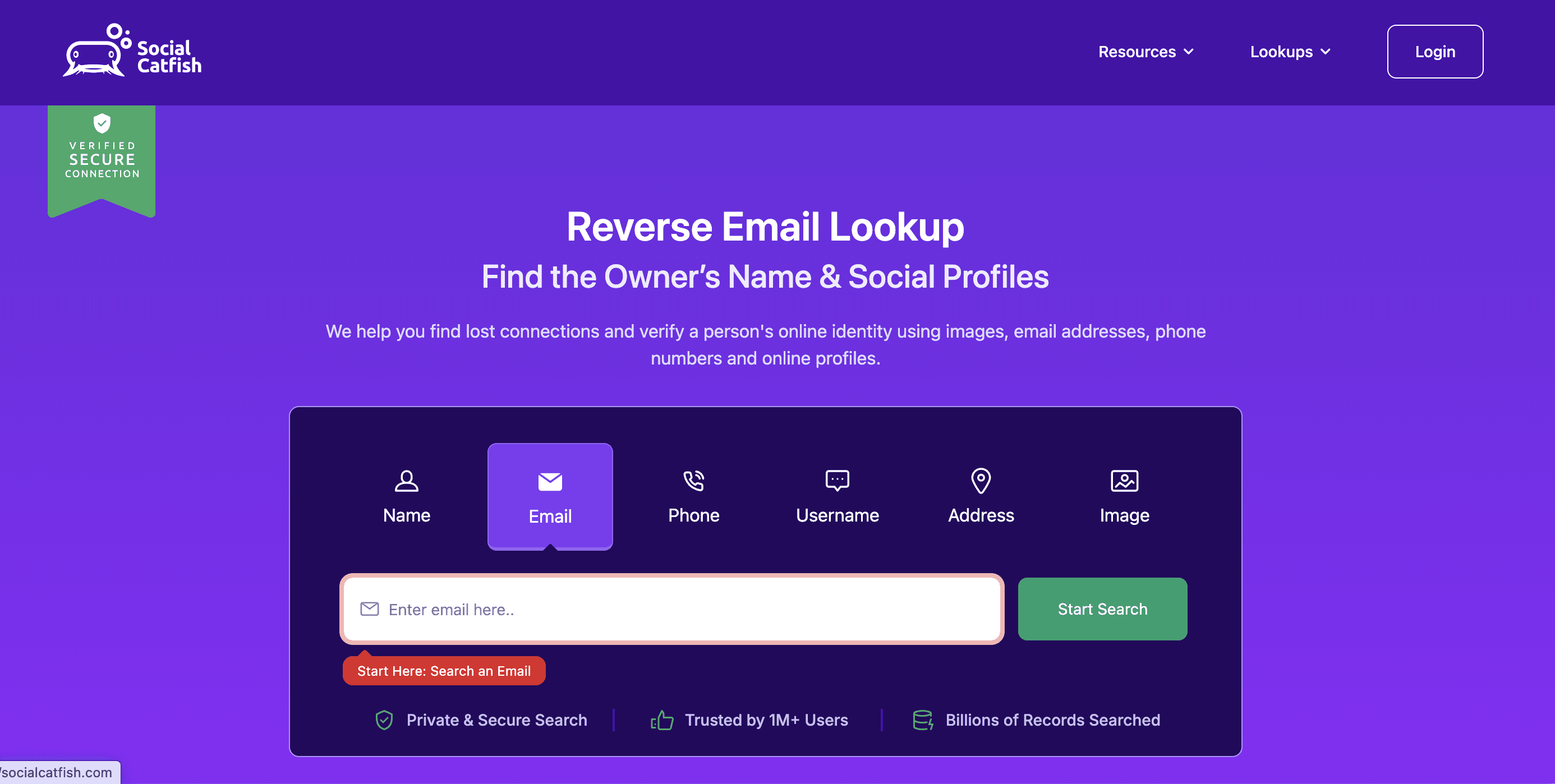
Social Catfish is one of the most widely known background check and identity verification tools.
It can be useful when you already have partial information and want to trace that identity across platforms.
What I found after testing
Social Catfish is genuinely useful for identity confirmation, but it is not specialized for real-time dating activity detection.
Think of it as a verification layer, not necessarily the first discovery tool.
Best use cases
Use Social Catfish for:
username checks
phone number lookup
email lookup
reverse photo search
romance scam verification
catfish investigation
Limitations
Its free preview is limited.
Meaningful results usually require a paid plan.
It is best used after you already have a clue to verify.
6. Have I Been Pwned
Type: Data breach lookup
Best for: Discovering if an email appears in leaked databases
Website: Have I Been Pwned
Have I Been Pwned is the most underrated tool on this list.
It is a free service that shows whether an email address has been exposed in a known data breach.
Why it matters for relationship investigations
Several dating, adult, and social platforms have suffered major breaches over the years.
If an email appears in one of those breaches, it can show that the account existed at some point.
That does not automatically prove current infidelity.
But it is a signal worth reviewing in context.
What I found after testing
This step surfaces information that many other tools cannot replicate.
It is free, instant, and does not require a photo.
I recommend it as a standard step in any cautious investigation workflow.
Limitations
It only shows known breaches.
If an account was never breached, it will not appear.
It also does not prove current dating app activity.
7. ProfileFinder.ai
Type: Cross-platform dating profile scanner
Best for: First-pass investigation with name, age, gender, and location
Website: ProfileFinder.ai
ProfileFinder.ai is one of the broadest-coverage tools for first-pass dating profile detection in 2026.
It is especially useful when you do not know which app the person might be using.
Instead of forcing you to guess between Tinder, Hinge, Bumble, Grindr, Badoo, or niche apps, it lets you search with basic identity details.
What distinguishes it from single-app scanners
Single-app scanners can be useful, but they are narrow.
A Tinder-only tool misses someone using Hinge.
A face search tool misses closed dating platforms.
A breach checker misses accounts that were never leaked.
This tool is useful because it gives you a wider starting point.
Radar monitoring
The Radar feature adds ongoing monitoring.
Instead of relying on one search at one moment, it can help track detected profile activity and alert you to changes over time.
Best use cases
Use it for:
hidden dating profile searches
first-pass investigation
Tinder, Hinge, Bumble, Grindr, and broader platform checks
suspicious relationship behavior
ongoing profile monitoring
cases where you do not have a strong photo
Limitations
No tool should be treated as a final verdict.
Use results as evidence to review and verify alongside other signals.
🧠 4. How to Read the Results Without Jumping to Conclusions
One of the most consistent errors people make after running these tools is treating a result, or a lack of result, as definitive.
That is risky.
Digital tools can surface evidence, but they do not understand relationship context.
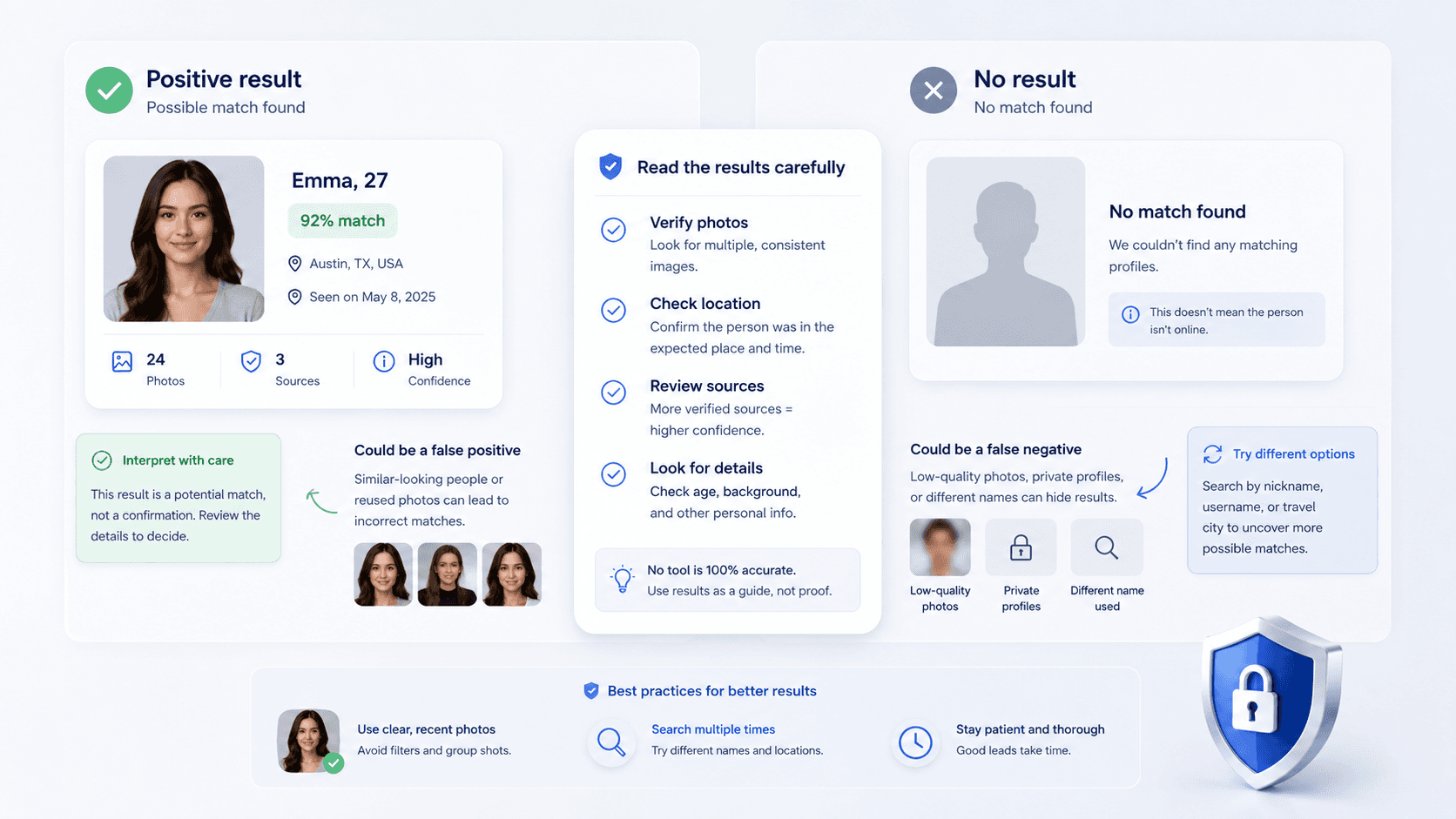
What a positive result means
A positive result means there may be an active or recently active profile that matches the inputs you provided.
It is evidence worth examining.
It is not automatic proof of infidelity.
Next steps after a positive result
After a positive result, do this:
Review the profile photos carefully.
Run a reverse image search to check for stolen images.
Check any visible activity timestamp.
Compare the listed location with where the person claims to be.
Cross-reference with FaceCheck.ID or PimEyes if you have a photo.
Save screenshots before confronting anyone.
What a negative result means
A negative result means no matching profile was found across the platforms scanned with the inputs provided.
It reduces likelihood, but it does not eliminate the possibility.
Reasons for false negatives
False negatives can happen when:
the person uses a nickname
the profile uses a different age
the location is set to another city
the profile is hidden or paused
the app is not included in the tool’s coverage
the photo is too low-quality for face search
When results are ambiguous, adjust the inputs.
Try a nickname, a recent travel city, a slight age variation, or a different photo.
🚩 5. Behavioral Signs That Pair With Digital Evidence
After testing 43 tools, the strongest signal usually comes from combining digital evidence with behavioral patterns.
None of these signs prove cheating by themselves.
But when they appear alongside a positive digital result, they can form a clearer picture.
Phone behavior
Watch for patterns such as:
the phone always being placed face-down
a passcode changed without explanation
defensive reactions when asked about the phone
new vault, calculator, or privacy apps
notifications silenced selectively
sudden privacy rules that did not exist before
Routine changes
Routine changes can matter when they are sudden and unexplained.
Examples include:
more evening or weekend “work”
sudden gym attendance without visible fitness goals
unusual focus on appearance before routine trips
unexplained charges on shared accounts
more solo errands or vague plans
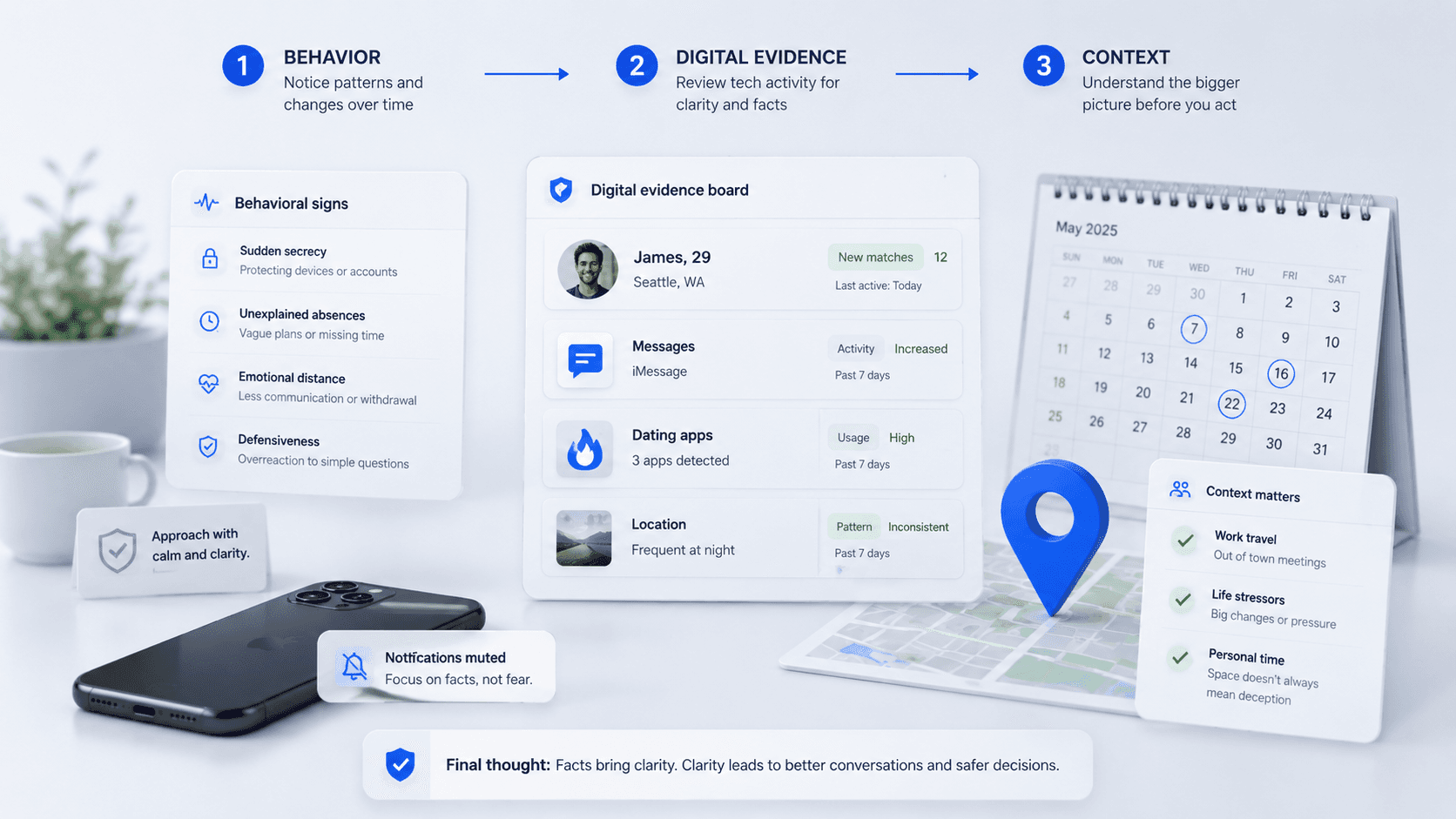
Emotional distance
Emotional distance can show up as:
less physical affection
more irritability
conversations being deflected
sudden secrecy
less shared planning
discomfort around ordinary questions
Again, none of these signs are proof alone.
But combined with digital evidence, they may be worth paying attention to.
🌐 6. High-Authority Resources for Digital Safety and Privacy
For deeper reading on scams, privacy, image abuse, and online safety, these sources are worth bookmarking.
Electronic Frontier Foundation: Digital Privacy and Surveillance
National Domestic Violence Hotline: If Infidelity Involves Abuse
Cyber Civil Rights Initiative: If Someone Leaks Your Private Photos
❓ 7. 15 Frequently Asked Questions
Q1. What is Profacefinder and how does it work?
Profacefinder is a facial recognition search tool that attempts to match a face across publicly indexed web images and social profiles.
It works by analyzing facial geometry from an uploaded photo and comparing it against its database.
Results quality depends heavily on photo resolution and the breadth of the platform’s index.
Q2. Is Profacefinder free?
Most Profacefinder-type tools offer a limited free preview with blurred or partial results.
Full match details typically require a paid subscription or per-search credit.
Q3. What is the best Profacefinder alternative in 2026?
FaceCheck.ID is one of the most focused alternatives for dating and social profile matching.
PimEyes offers broader open-web coverage.
For investigations where you do not have a photo, a name-based scanner covering multiple platforms is usually more practical than any facial recognition tool.
Q4. Is Cheaterbuster legit?
Yes, Cheaterbuster is a real functioning product.
It searches Tinder by name, age, and location.
Its limitations are platform scope and cost.
In 2026, Tinder-only coverage may miss too much of the dating app landscape.
Q5. What is a Cheaterbuster free alternative?
Several tools offer partial free results for dating profile searches.
For a first-pass investigation with no cost, try combining a free name-based search with a Have I Been Pwned email check.
Both can provide useful signals without a subscription.
Q6. How do I find out if someone is on Tinder in 2026?
In-app Tinder search by name is extremely limited.
The most reliable method is to use a third-party scanner that checks Tinder alongside other platforms using name, age, and location.
Remember that Tinder profiles can reflect recent location, so search recent travel cities too.
Q7. Can I do a Tinder profile search free?
Free Tinder profile lookup tools exist, but they often return blurred or incomplete results.
Partial results can still be useful for confirming whether a profile may exist before committing to a paid search.
Q8. What is the difference between Cheaterbuster, cheat buster AI, and cheatbuster AI?
These are common name variations referring to the same product category.
They usually describe tools that search dating platforms by name, age, and location.
Some refer specifically to Cheaterbuster, while others describe the category more generally.
When evaluating any “cheat buster AI” tool, check which platforms it covers and whether results are real-time or cached.
Q9. Is Social Catfish free?
Social Catfish offers a limited free preview.
Full results generally require a paid subscription.
It is best used as a verification tool once you already have a username, phone number, email, or photo.
Q10. What is Cheateye.ai or Cheat Eye?
Cheateye.ai is a newer entrant in the dating profile scanner category.
It functions similarly to other dating profile search tools, but platform coverage and pricing may differ.
Always check whether a tool covers the platforms you actually care about before paying.
Q11. How do I find someone’s OnlyFans by username?
OnlyFans has its own search function for usernames.
For people who changed or hid their username, reverse image tools like PimEyes or FaceCheck.ID may surface public pages if a face match exists.
OnlyFans lookup by phone number is not natively supported by the platform.
Q12. What should I do if someone leaks my private photos?
Contact the Cyber Civil Rights Initiative and document everything before attempting removals.
Take screenshots, save URLs, and preserve timestamps.
Many countries now have laws against non-consensual intimate image sharing.
Q13. How does reverse video search work?
Reverse video search tools work by extracting key frames from a video and running them as image searches.
For investigation purposes, they can help trace where a video originated or confirm whether a person in a video matches known photos.
Q14. What is PimEyes face recognition search and how accurate is it?
PimEyes scans a large crawled index of public web images and attempts to surface matches for an uploaded face.
Accuracy varies by photo quality, lighting, angle, and how much of the web has indexed the person’s face.
It remains one of the most powerful open-web facial recognition tools available to consumers, but it can generate off-topic results.
Q15. How do I check if someone is on dating apps without them knowing?
The most private method is using a third-party dating profile scanner that operates independently from the apps themselves.
No login, no app access, and no direct notification to the person being searched.
Use a private browser connection if you are on a shared device.
📚 8. Related Readings
Continue with these in-depth guides:
Top 7 Swindlerbuster Alternatives That Actually Work in 2026
Cheaterbuster Free Alternative: What Actually Delivers Results
7 Best Ways to Do a Tinder Profile Search Without an Account
✅ Final Thoughts
The landscape of relationship verification tools in 2026 is broader, faster, and more accessible than it has ever been.
But the core challenge has not changed.
No single tool gives you a complete picture.
After testing 43 tools over the past 18 months, my consistent finding is this:
The most reliable investigations combine a name-based multi-platform scan, an email breach check, and facial recognition if a photo is available.
Each layer compensates for the blind spots of the others.
Profacefinder and its alternatives are valuable specifically when you have a photo to work with.
When you do not, facial recognition tools are the wrong starting point.
You will usually get further, faster, with a broader platform scanner.
Whatever you find, treat results as evidence to weigh, not as final verdicts.
And if the evidence points in a direction you were hoping it would not, remember this:
Clarity, even painful clarity, is the foundation for every decision that comes next.