

If you are searching for "Cheatbuster AI", you have likely encountered viral videos, forum debates, or social media claims promising an artificial intelligence tool that can instantly expose whether a partner is active on dating apps. But behind the catchy name lies a mix of branding evolution, real technical capabilities, and significant limitations that marketing rarely explains.
Whether you suspect infidelity, are verifying an old profile, or want to understand how third-party dating scrapers operate, navigating these tools requires separating software reality from sensational marketing.
Editorial Disclosure: ProfileFinder.ai publishes this objective analysis and operates an independent dating profile search engine. We maintain strict editorial integrity: our review of Cheatbuster (Cheaterbuster) is based exclusively on publicly verified pricing terms, real checkout flows, technical platform limitations, and documented user experiences. We never publish unsupported accuracy scores or defamatory allegations.
Quick Answer
"Cheatbuster AI" is the widespread colloquial name for Cheaterbuster (originally launched in 2014 as Swipebuster), a third-party paid tool that searches public Tinder profiles. It queries Tinder's discoverable user feed using a person's first name, approximate age, and geographic location coordinate.
Cheatbuster searches only Tinder—it does not scan Bumble, Hinge, or private messaging apps, and it cannot detect accounts with Tinder's "Discovery" toggle turned off. Furthermore, finding a profile does not prove present-day cheating, as millions of dormant accounts remain indexed after users delete the app from their phones. For broader multi-platform verification, independent services like ProfileFinder offer a structured alternative.
What Is Cheatbuster AI? Clearing the Naming Confusion
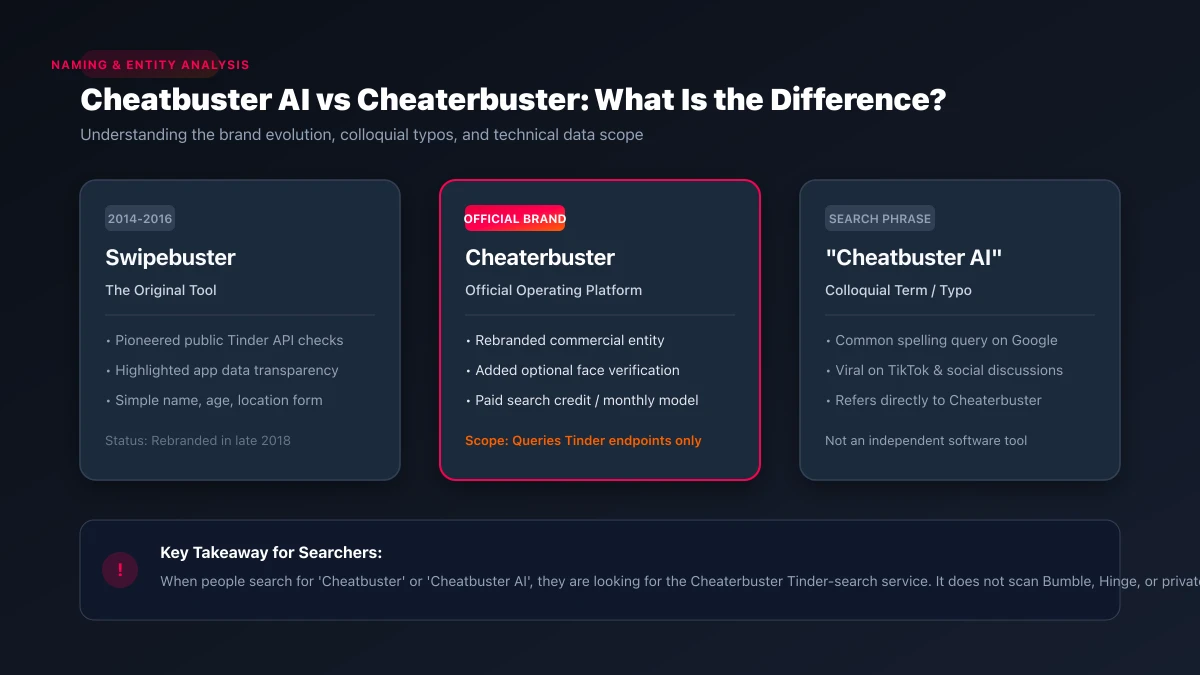
One of the primary sources of confusion for consumers is the name itself. Many searchers look for "Cheatbuster," "Cheatbuster AI," or "Cheat Busters," assuming it is a standalone artificial intelligence startup that scans every corner of the internet. In reality, these queries all refer to the same service: Cheaterbuster.
The service has a well-documented history in the digital dating landscape:
2014–2016 (Swipebuster): The platform originally launched under the name Swipebuster. Its founders created it primarily to demonstrate how easily third parties could query publicly accessible endpoints in Tinder's application programming interface (API) using basic parameters like first name, age, and GPS coordinates.
2018–Present (Cheaterbuster): The tool rebranded as Cheaterbuster to align more directly with relationship investigation demand. Over time, it introduced facial recognition matching to help users filter through multiple profiles sharing the same name.
The "Cheatbuster AI" Phenomenon: On platforms like TikTok, YouTube, and Reddit, creators and affiliates frequently drop the middle syllable, referring to the site casually as "Cheatbuster AI." Despite the AI branding, the underlying core mechanism remains an automated query against Tinder's discovery database.
If you are researching the service, understand that Cheatbuster and Cheaterbuster are the exact same platform. If you want a deep dive into its trustworthiness and billing track record, explore our dedicated review on whether Cheaterbuster is legit.
How Cheatbuster Works: The Technical Reality
Contrary to popular belief, Cheatbuster does not employ secretive hackers, nor does it possess backdoor access to private database servers. It functions as an automated search client querying public dating data. Here is the actual technical workflow:
Input Parameters: The user provides a subject's first name, biological age (or age range), and an approximate search city or ZIP code. An optional headshot photo can be uploaded for computer vision facial matching.
Virtual Coordinate Placement: The service places a virtual geolocation pin at the requested coordinates and queries Tinder's discoverable user card stack within a specified radius.
Data Filtering: The software scrapes through returned profile cards, filtering candidate results that match the specified name and age bracket.
Report Generation: If candidate cards are identified, the platform compiles a report displaying the public profile photos, bio text, reported distance from the coordinate pin, and the last active timestamp associated with the profile.
Because the search relies on discoverable profile cards, anything outside Tinder's public stack is invisible to the tool. For an in-depth breakdown of search reliability, read our guide on how Cheaterbuster works in practice.
What a Cheatbuster Search Can Actually Tell You
When Cheatbuster returns a result, what does the data genuinely signify? It is crucial to evaluate the output objectively rather than jumping to emotional conclusions.
1. Profile Existence on Tinder
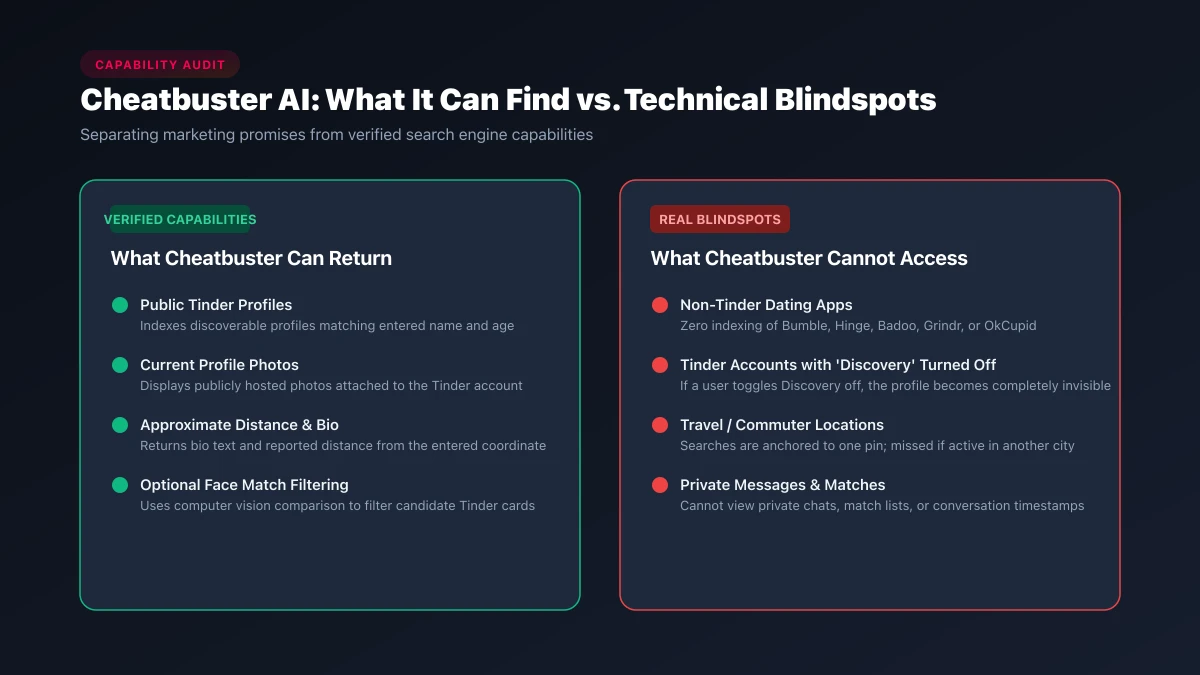
A positive match confirms that a Tinder account was created under that first name, age, and photo set within the queried region. It provides visual access to public profile pictures, prompt answers, and bio descriptions.
2. Approximate Distance and Location
The report typically shows how many miles away the profile was from the search pin when the data was retrieved. This helps verify whether the profile corresponds to a local resident or someone who swiped while traveling.
3. Last Active Timestamps
Cheatbuster attempts to estimate when the account was last active. However, this timestamp reflects when Tinder's servers last logged account activity or updated discovery cards—which can sometimes be triggered by background app syncs, push notification refreshes, or cached session tokens rather than active human swiping.
Key Technical Limitations and Blindspots
Before spending money on any dating investigation tool, users must be aware of its structural limitations. Cheatbuster has several critical blindspots that frequently lead to false negatives or misinterpretations:
1. Single-Platform Focus (Tinder Only)
Cheatbuster operates exclusively on Tinder. In 2026, modern singles and dating app users are spread across diverse platforms. If a partner is using Bumble, Hinge, Badoo, OkCupid, or niche dating apps, Cheatbuster will return zero results. A negative report on Cheatbuster does not mean a person is absent from online dating.
2. Tinder's "Discovery" Toggle
Tinder provides a built-in privacy setting called "Show me on Tinder" (Discovery toggle). If an account holder pauses their profile or turns Discovery off, their profile card is immediately removed from the swiping stack. Cheatbuster cannot locate accounts with Discovery disabled, even if the person actively chats with existing matches.
3. The Commuter & Travel Blindspot
Cheatbuster searches are anchored to a specific GPS coordinate. If a partner commutes 30 miles to an office, visits clients across town, or travels for business, searches centered on your home ZIP code may miss their profile entirely if their search radius does not overlap your pin.
4. Common Name Ambiguity
In densely populated metropolitan areas (such as New York, London, or Los Angeles), searching for common names like "Michael, 31" or "Jessica, 27" can return dozens of distinct individuals. Without the optional facial recognition filter, identifying the correct person requires careful manual scrutiny.
5. Dormant Accounts vs. Active Cheating
A widespread misconception is that an active profile proves current infidelity. In reality, millions of smartphone owners simply delete the Tinder application icon from their phone's home screen when entering a relationship without officially navigating to Settings and deleting their account. That account remains dormant in Tinder's system for months or even years. For a comprehensive overview of non-paid checks, see our review of Cheaterbuster free alternatives.
Pricing, Search Credits, and Billing Fine Print
A frequent complaint across consumer review forums regarding Cheaterbuster / Cheatbuster involves payment terms and subscription expectations. Here is what searchers should know before submitting credit card information:
No Free Searches: Cheatbuster is not a free service. Submitting search inputs is free, but accessing any blurred results or detailed reports requires payment.
Single Searches vs. Credit Bundles: Individual searches generally start around .99 to .99 depending on promotional tiers, with bulk search credits offered for repeated queries.
Auto-Renewing Subscriptions: Certain purchase tiers enroll customers in an auto-renewing weekly or monthly subscription. If you only intend to perform a single check, carefully inspect the checkout page and cancel any active subscription in your account settings immediately after completing your search.
Strict No-Refund Policies: Because search resources and server queries execute instantaneously, Cheaterbuster enforces a strict policy against refunds, regardless of whether your search yields a matching profile or returns zero results.
Cheatbuster AI vs ProfileFinder: Feature Comparison
When evaluating digital profile verification, different tools serve different needs. The following comparison highlights key distinctions between Cheatbuster and ProfileFinder:
| Feature / Dimension | Cheatbuster AI (Cheaterbuster) | ProfileFinder.ai |
|---|---|---|
| Platform Coverage | Tinder exclusively | Multi-app dating profile search (including Tinder) |
| Primary Search Inputs | First name, age, city/ZIP, optional photo | First name, approximate age bracket, location |
| Dating Ecosystem Scope | Single app scraper | Broad dating profile discovery engine |
| Hidden Discovery Detection | Cannot detect accounts with Discovery off | Detects publicly indexable profile records |
| Billing Structure | Search credits or recurring subscription | Transparent search credits with clear terms |
| Account Requirement | Account creation mandatory before viewing full results | Direct web search workflow |
| Ethical Safeguards | Relies on single-platform scraper output | Emphasizes multi-step evidence verification ladder |
How to Check Dating Profiles With ProfileFinder
If your goal is to verify whether a partner has an active presence on dating apps without relying on a single Tinder-only scraper, ProfileFinder provides a structured, multi-platform search workflow. Follow these four steps:
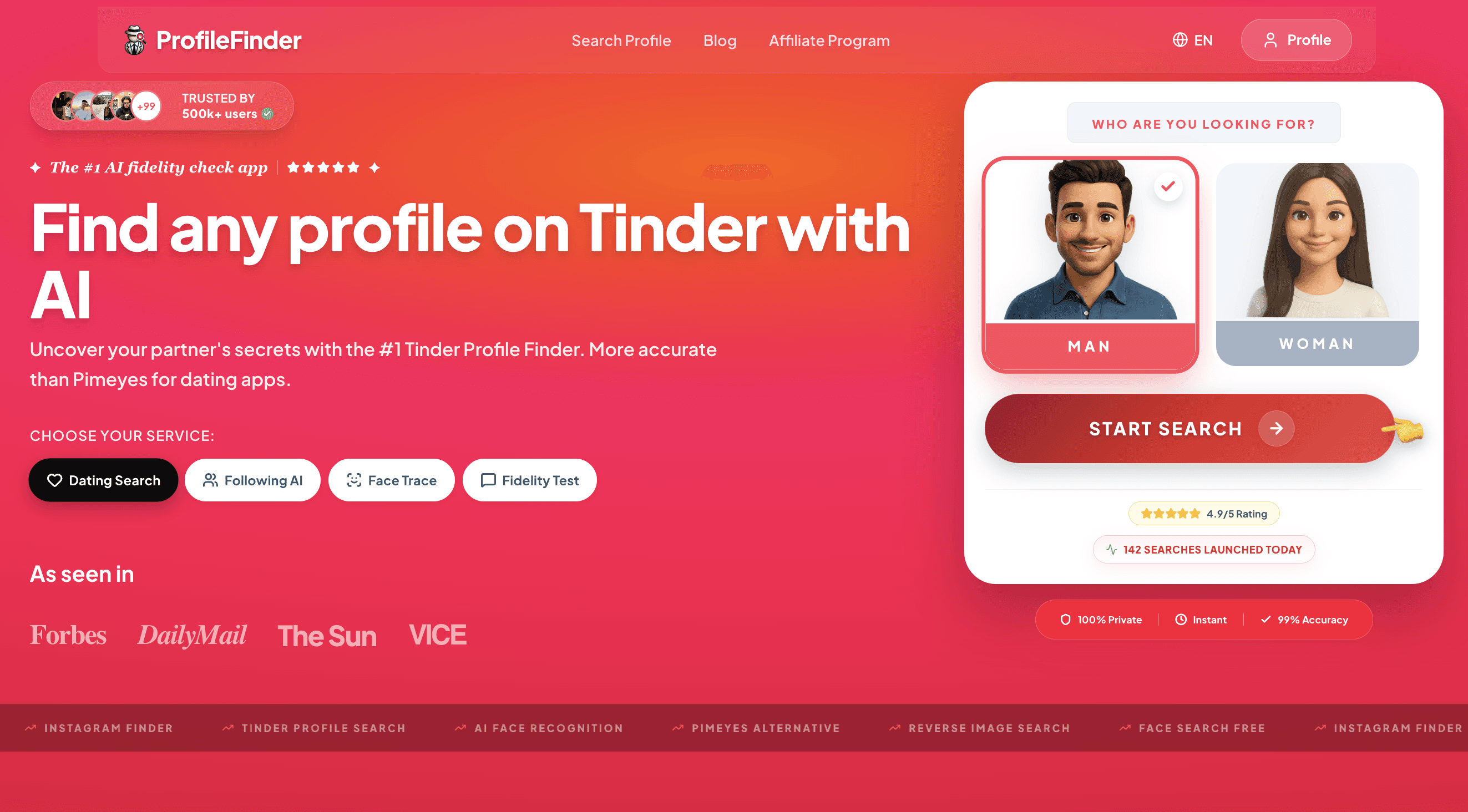
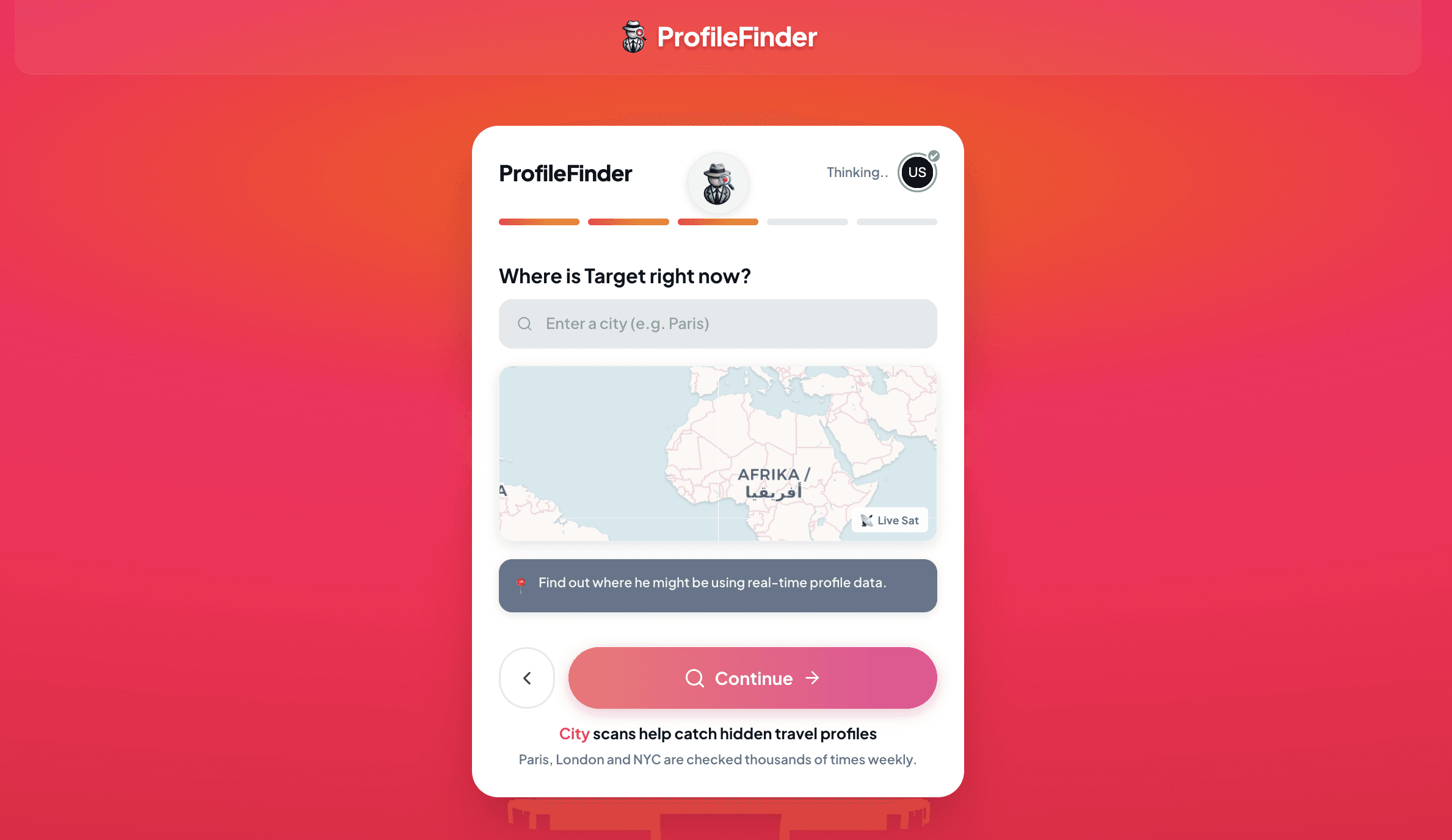
Step 1: Open the Dating Profile Search
Navigate to ProfileFinder's dedicated dating profile search. The interface is web-based, requires no intrusive phone software installations, and operates privately from any browser.
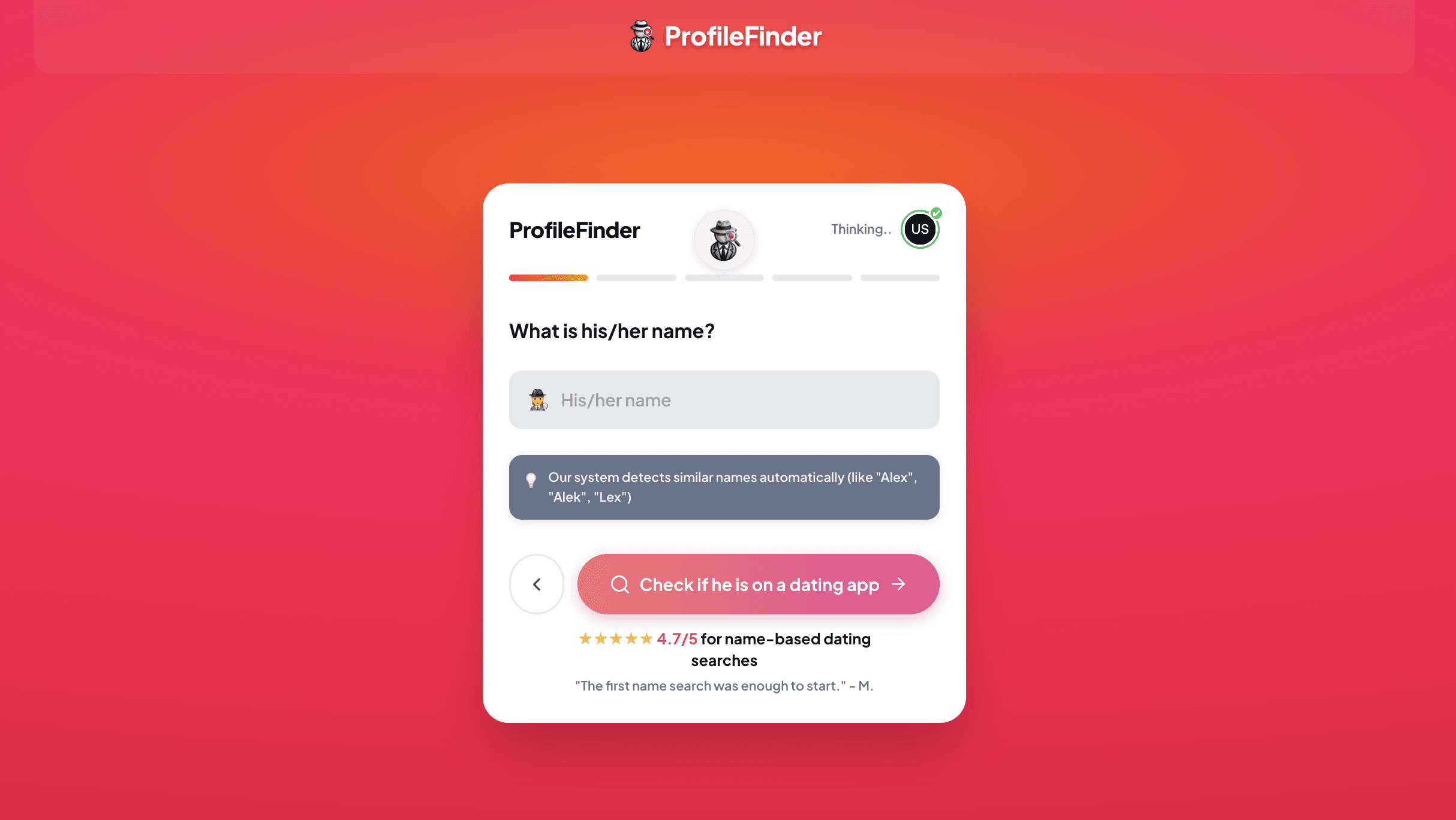
Step 2: Enter Their First Name
Type the person's real first name. If your partner frequently uses a common nickname (such as "Mike" instead of "Michael" or "Alex" instead of "Alexander"), consider running a follow-up query with the variation if the initial search is inconclusive.
Step 3: Specify Age and Geographic Location
Enter the person's age and select their primary city or metropolitan area. If the person frequently commutes to another city for work or university, searching adjacent cities can help catch profiles registered near workplaces.
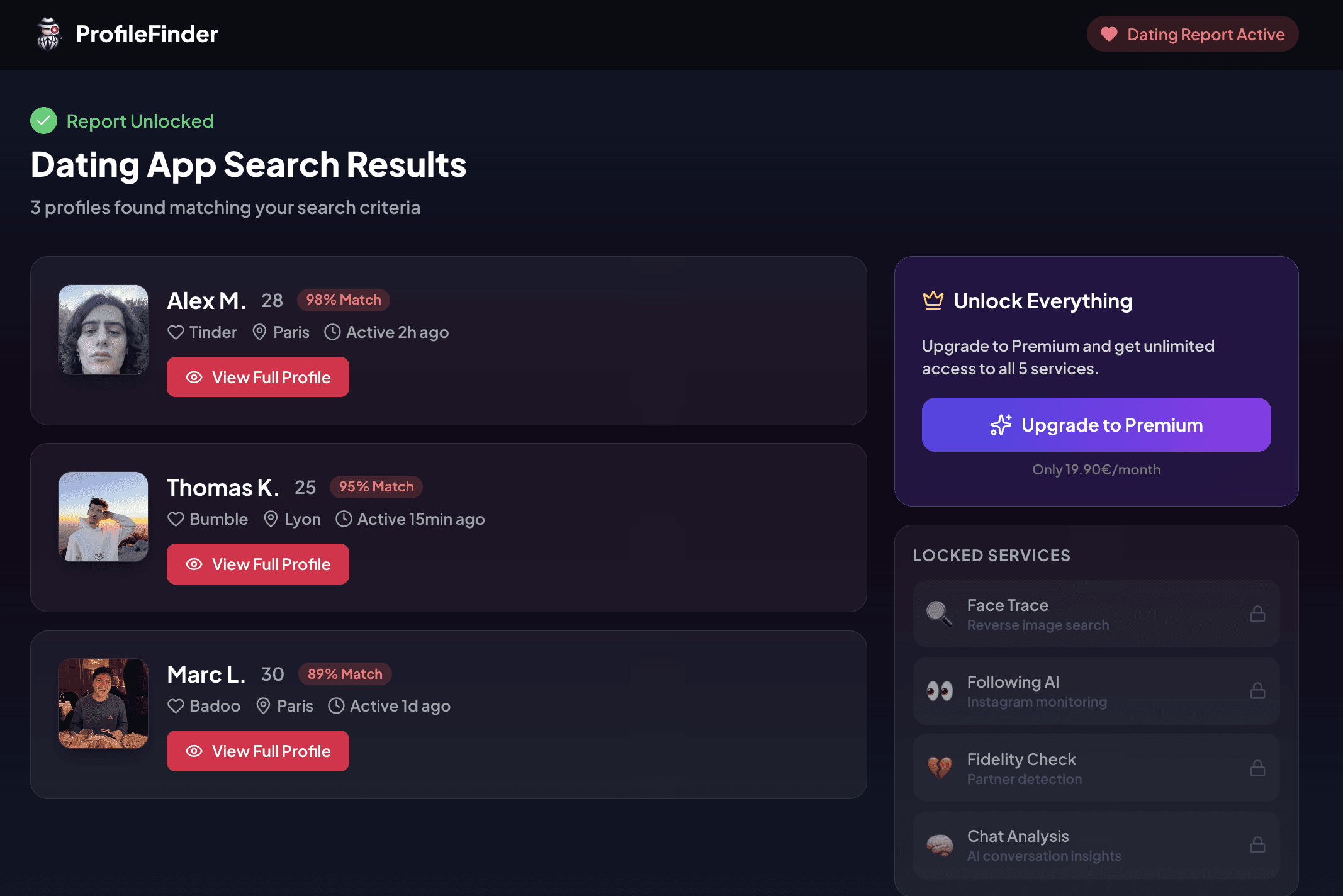
Step 4: Review Candidate Matches and Cross-Check Details
Review candidate profiles carefully. Look for distinctive visual markers, specific bio phrasing, connected hobbies, or verified photo details rather than assuming the first profile with a matching name belongs to your partner.
The Evidence Ladder: How to Interpret Results Responsibly
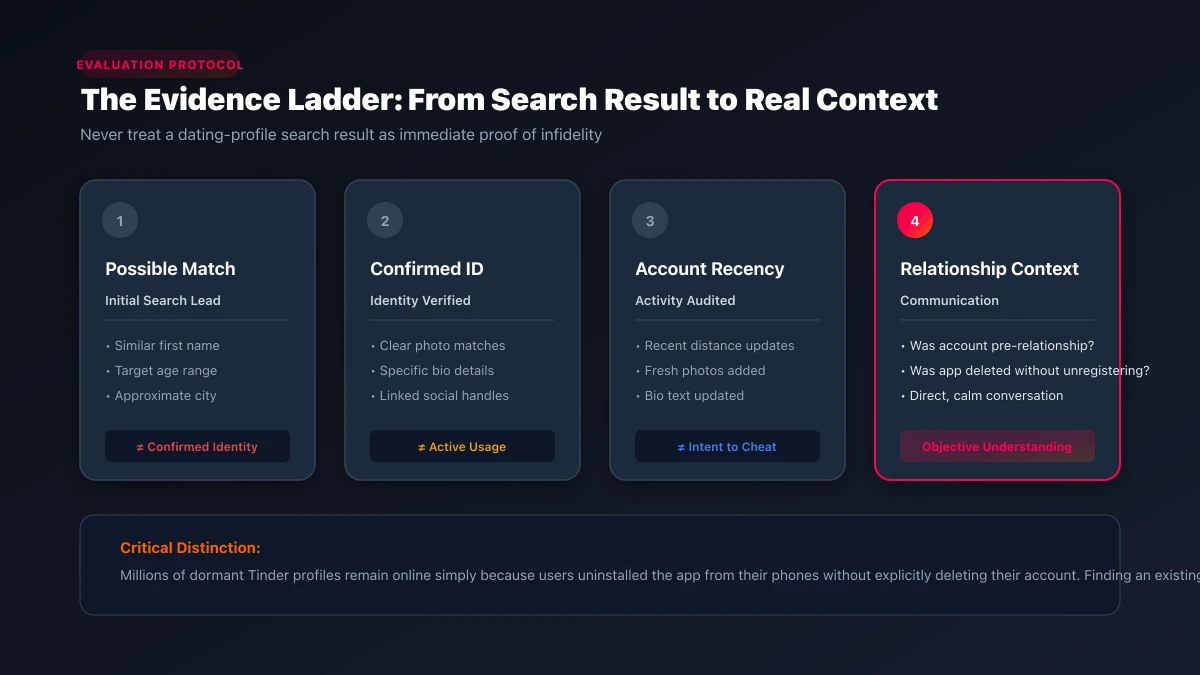
Investigating relationship suspicions is emotionally taxing. When someone sees an unfamiliar dating profile on a screen, confirmation bias often takes over. At ProfileFinder, we emphasize the Evidence Ladder—a four-stage framework designed to prevent premature accusations and misinterpretations:
Stage 1: Possible Match (Initial Lead): A search displays a profile with a matching name, age, and city. This is merely a candidate lead. In any medium-sized city, dozens of individuals share identical names and birth years.
Stage 2: Confirmed Identity (Visual Verification): You cross-reference unique photographs, distinct tattoo or clothing markers, specific university credentials, or recognizable pet photos. You have confirmed the account belongs to your partner—but you have not yet proven recent activity.
Stage 3: Account Recency (Freshness Audit): You examine recency signals: Are the photos recent hairstyles, or are they from five years ago before your relationship started? Is there a recent distance calculation? Remember that deleting an app icon does not delete the profile on Tinder's backend.
Stage 4: Relationship Context (Direct Communication): Digital search tools provide public data, but they cannot replace honest, calm relationship communication. A dormant profile created during a single period requires a completely different conversation than an actively updated account with recent photos.
For additional investigative safety principles, read our analysis on whether Cheaterbuster is legit and safe to use.
Frequently Asked Questions
Is Cheatbuster AI free to use?
No. While you can enter search parameters on the landing page for free, viewing unblurred results, full photo sets, and detailed account metrics requires purchasing search credits or subscribing to a paid plan.
Is Cheatbuster the same as Cheaterbuster?
Yes. "Cheatbuster" and "Cheatbuster AI" are common typos and colloquial names used on social media and discussion forums for Cheaterbuster (formerly Swipebuster). There is no separate official software called Cheatbuster AI.
Can Cheatbuster scan Bumble, Hinge, or Instagram?
No. Cheatbuster is engineered specifically to query Tinder's public discovery card stack. It has no capability to index Bumble, Hinge, Grindr, Badoo, or private social media accounts. To search across multiple dating apps, use a dedicated cross-platform tool like ProfileFinder.
Can Cheatbuster find an account if Tinder Discovery is turned off?
No. If a user disables the "Show me on Tinder" toggle in their app settings, their profile card is removed from public discovery queries. Cheatbuster will not be able to find or index the account while Discovery is paused.
Does finding a Tinder profile prove that my partner is cheating?
No. A profile match indicates that an account exists, but it does not determine intent or prove ongoing infidelity. Many accounts remain dormant after someone enters a relationship simply because the user uninstalled the app without completing the account deletion process in settings.
Related Readings 📚
Final Verdict: Should You Use Cheatbuster AI?
Cheatbuster (Cheaterbuster) is a functional, legitimate tool for what it was built to do: query public Tinder profile cards within a specific geographic coordinate. However, because it is strictly limited to Tinder, charges auto-renewing subscription fees, and cannot detect paused profiles, relying on it as a definitive relationship audit is flawed.
If you need clarity, approach digital searches methodically. Start with a multi-platform search on ProfileFinder, apply the Evidence Ladder to every candidate result, and remember that objective clarity should always lead toward honest communication rather than hasty conclusions.