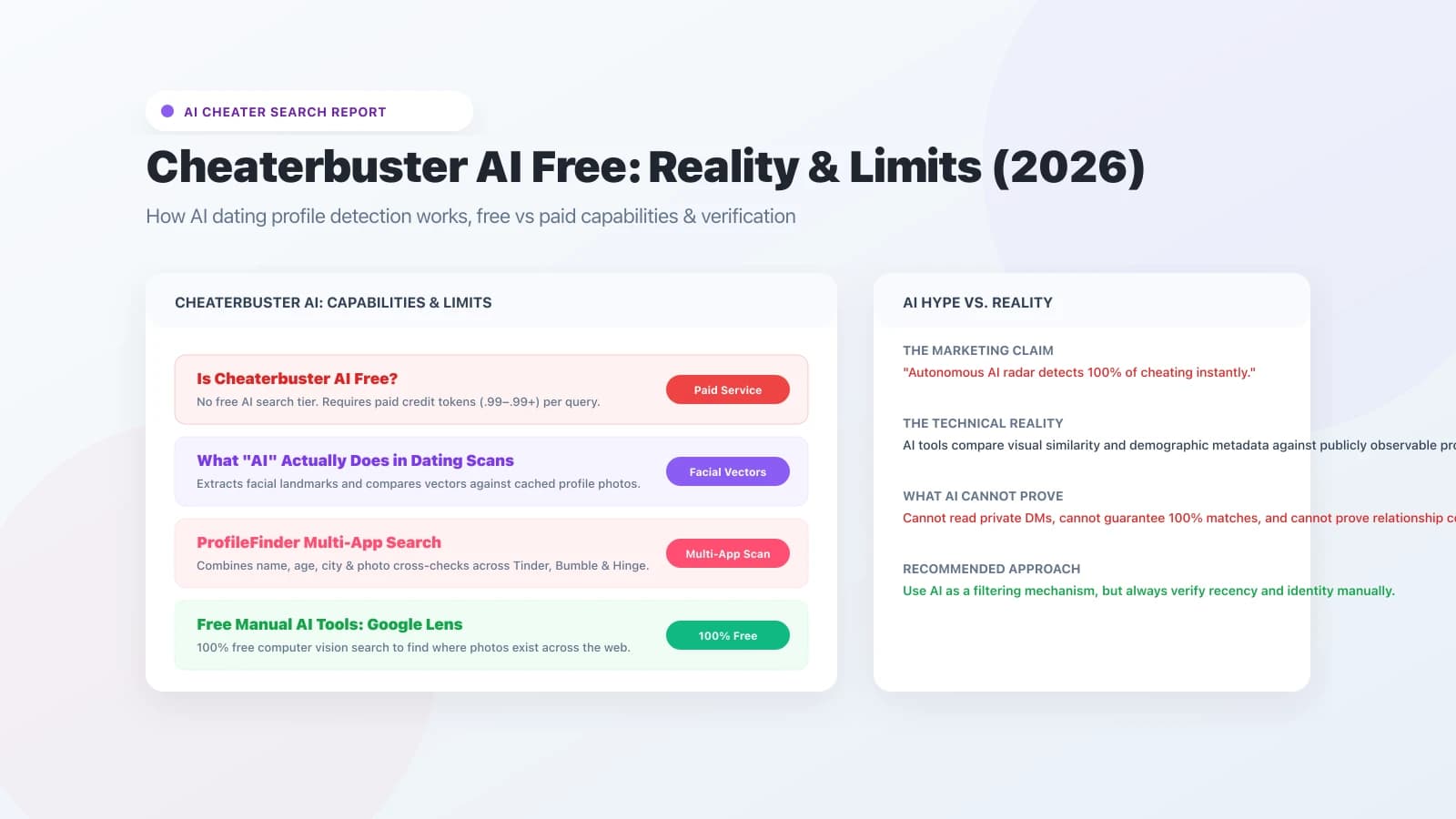

If you are asking “does Cheaterbuster work?”, you probably want something more useful than a yes-or-no review.
Cheaterbuster is an active profile-search service, and its current product is much broader than many older reviews suggest. But finding a possible dating profile, identifying the correct person, proving recent activity and proving cheating are four different conclusions.
Understanding that difference is the most important part of using any dating-profile search tool.
Editorial disclosure: ProfileFinder.ai publishes this guide and operates its own Tinder profile search service. Because we are a potential Cheaterbuster alternative, comparisons below are limited to features we can verify from current public product pages. We do not publish unsupported accuracy scores for either service.
Quick Answer
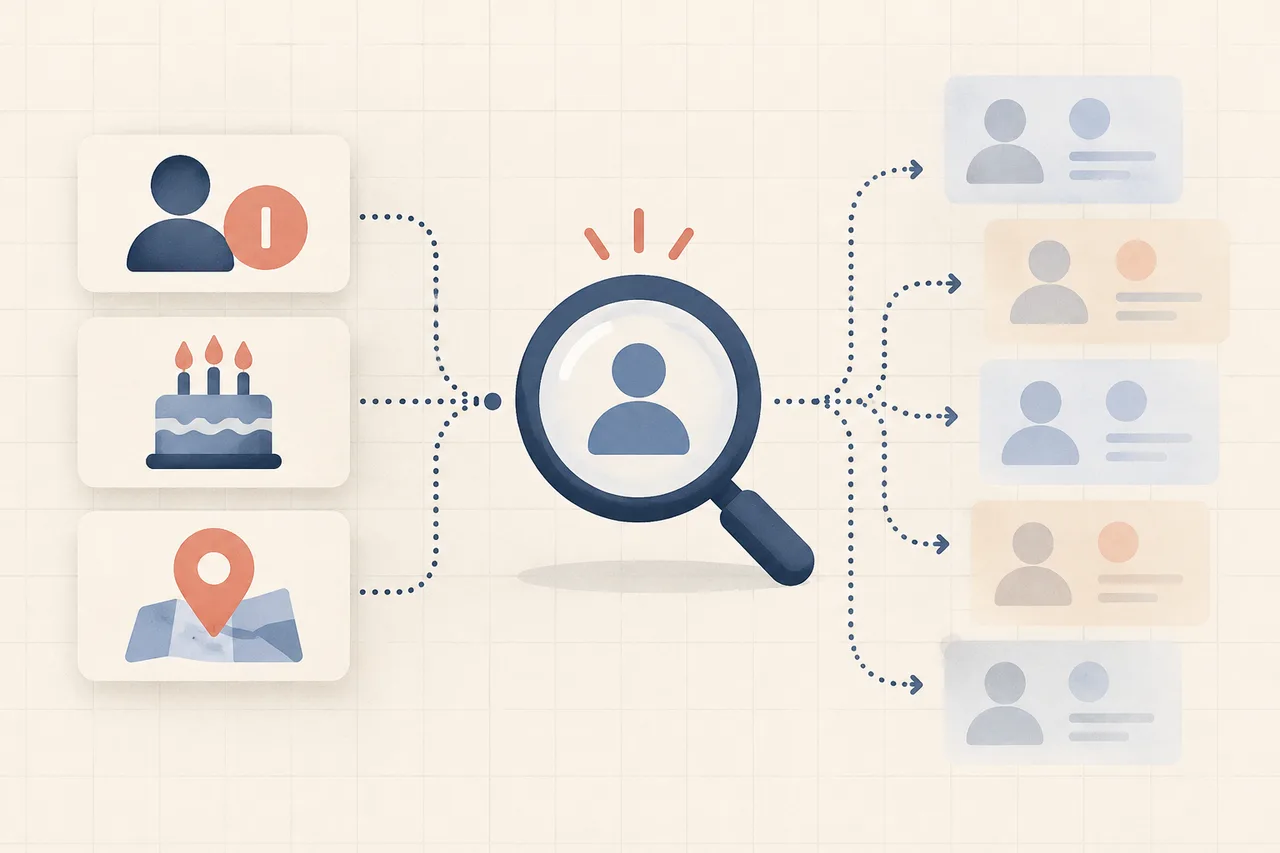
Yes, Cheaterbuster can work as a profile-search tool, but a result still needs verification. In 2026, Cheaterbuster says searches can use a first name, age, location and optional face input, with profile-change indicators and weekly monitoring available for active searches.
A strong match may indicate that a profile exists. It does not automatically prove recent use or cheating, while a “no match” does not prove that no Tinder account exists.
If the result matters, cross-check the identifying details through a separate Tinder-focused search such as ProfileFinder.ai before making a serious conclusion.
What Does Cheaterbuster Actually Do in 2026?
A major problem with Cheaterbuster reviews is that many still describe an older version of the service.
Cheaterbuster's current How It Works page says a search begins with a first name, approximate age and likely location. It also lists an optional face input, profile activity and change indicators, profile updates, weekly monitoring and account-history access.
Its current FAQ describes Cheaterbuster more broadly as an AI-powered service checking signals from public profiles, social sources, photos and public records. The FAQ also says a search subscription includes facial-recognition search, dating-app search, social analysis and weekly monitoring for one person.
That means several claims repeated in older articles are no longer safe to make.
It is no longer accurate to describe the current product simply as:
a Tinder-only lookup;
a tool with no face search;
a one-time search with no monitoring.
At the same time, Cheaterbuster's public pages do not clearly provide an exhaustive list of every dating app covered by its search.
That distinction matters.
We should not repeat outdated claims that Cheaterbuster searches only Tinder, but we also should not assume one search definitively checks every dating platform.
Does Cheaterbuster Actually Work?
It can.
The more useful question is what exactly you expect it to prove.
Question |
What Cheaterbuster may help establish |
What it cannot establish by itself |
|---|---|---|
Can it find a profile? |
A possible profile matching the search criteria |
That every relevant profile has been found |
Is it the right person? |
Photos, age, location and other matching details can strengthen identification |
That a weak name/location match is definitely the person |
Is the profile active? |
Clearly defined recent changes or activity signals may provide useful evidence |
That an existing profile is necessarily being used now |
Does it prove cheating? |
A verified recent profile may justify further questions |
The reason for the profile or the boundaries of a relationship |
The first three questions are technical.
The final question is contextual.
A search engine cannot determine the agreements inside someone's relationship.
Keep These Four Levels Separate
Possible match → confirmed identity → recent activity → relationship context
The mistake is jumping from:
“I found a matching profile.”
directly to:
“This proves cheating.”
It does not.
A profile may predate a relationship. An account may still exist after someone stops using the app. People can also hide Tinder profiles without deleting their account.

How to Cross-Check a Cheaterbuster Result With ProfileFinder.ai
When one search gives you an uncertain answer, running the same search repeatedly through the same system rarely adds much information.
A better approach is to compare it with a separate search workflow.
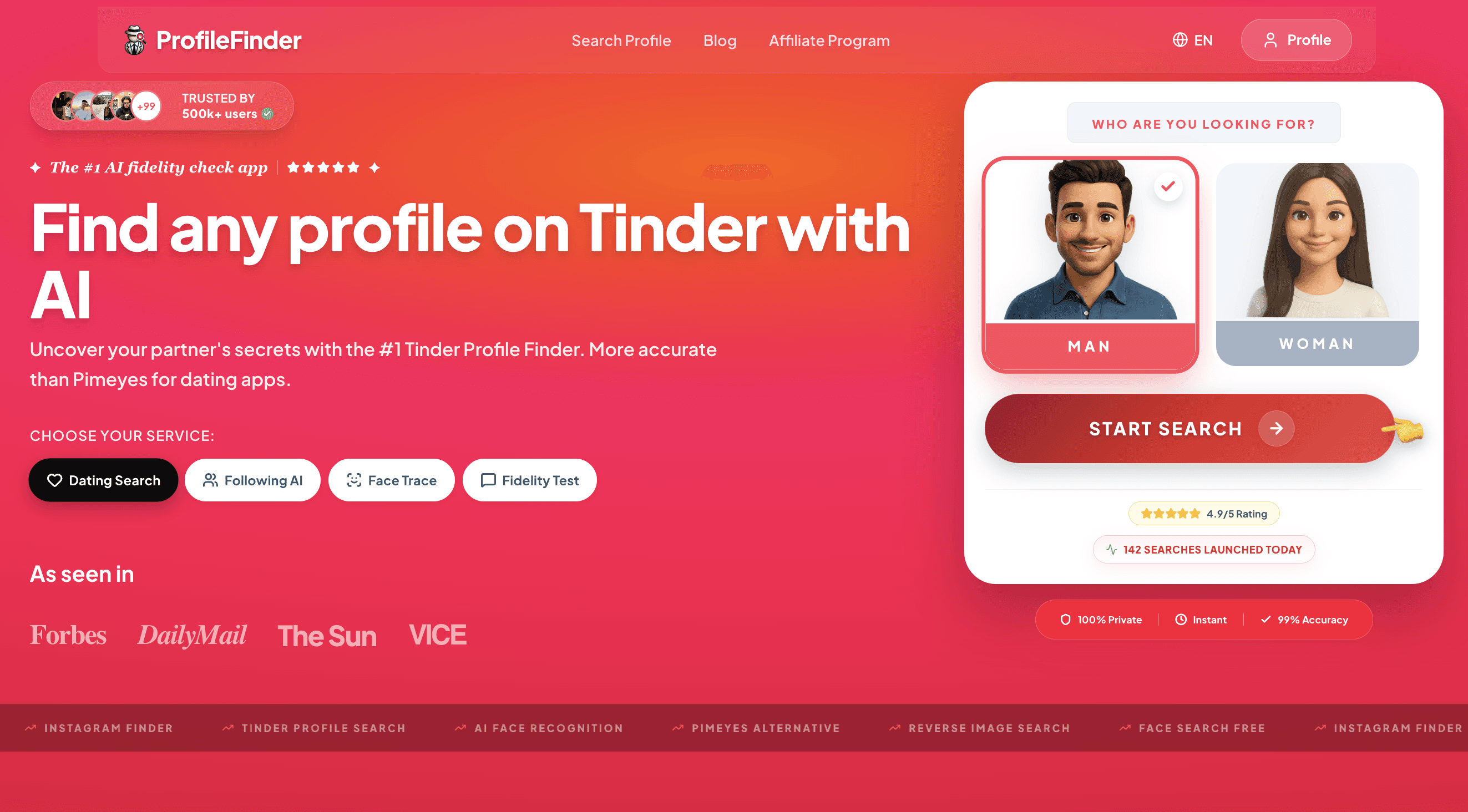
ProfileFinder.ai currently focuses its Dating Search on Tinder profile lookup using a first name, approximate age and city. Its current interface also offers optional photo input and lets users review likely profile matches and activity-related information.
This makes it useful as a second check when:
Cheaterbuster returns several possible people;
a Cheaterbuster match looks plausible but not conclusive;
Cheaterbuster returns no result;
you specifically want to investigate a possible Tinder profile.
How to Use ProfileFinder.ai Step by Step
Step 1 — Go to ProfileFinder.ai
Open ProfileFinder.ai Dating Search.
You do not need to begin with private account credentials or access to someone else's phone.
Use identifying details you already legitimately know.
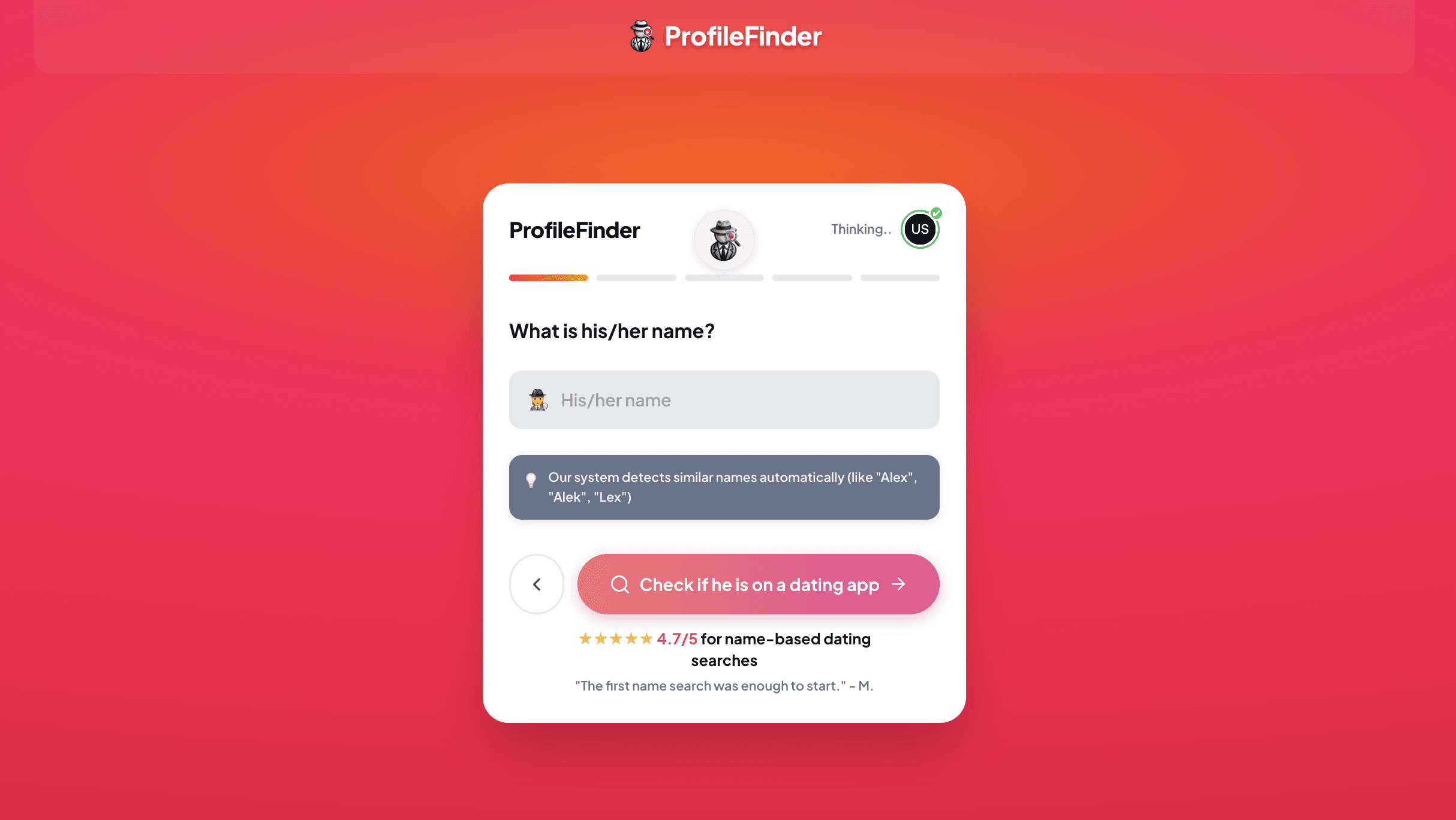
Step 2 — Enter the First Name
Use the first name the person is most likely to use on Tinder.
A name by itself is weak evidence, especially when it is common.
Its value comes from combining it with other identifying information.
Step 3 — Add the Approximate Age
Enter the closest age you know.
Age helps reduce unrelated results when several people share the same first name.
Do not automatically reject a plausible result because the age differs slightly. Information on profiles can be outdated or inaccurate, so treat age as one signal rather than absolute proof.
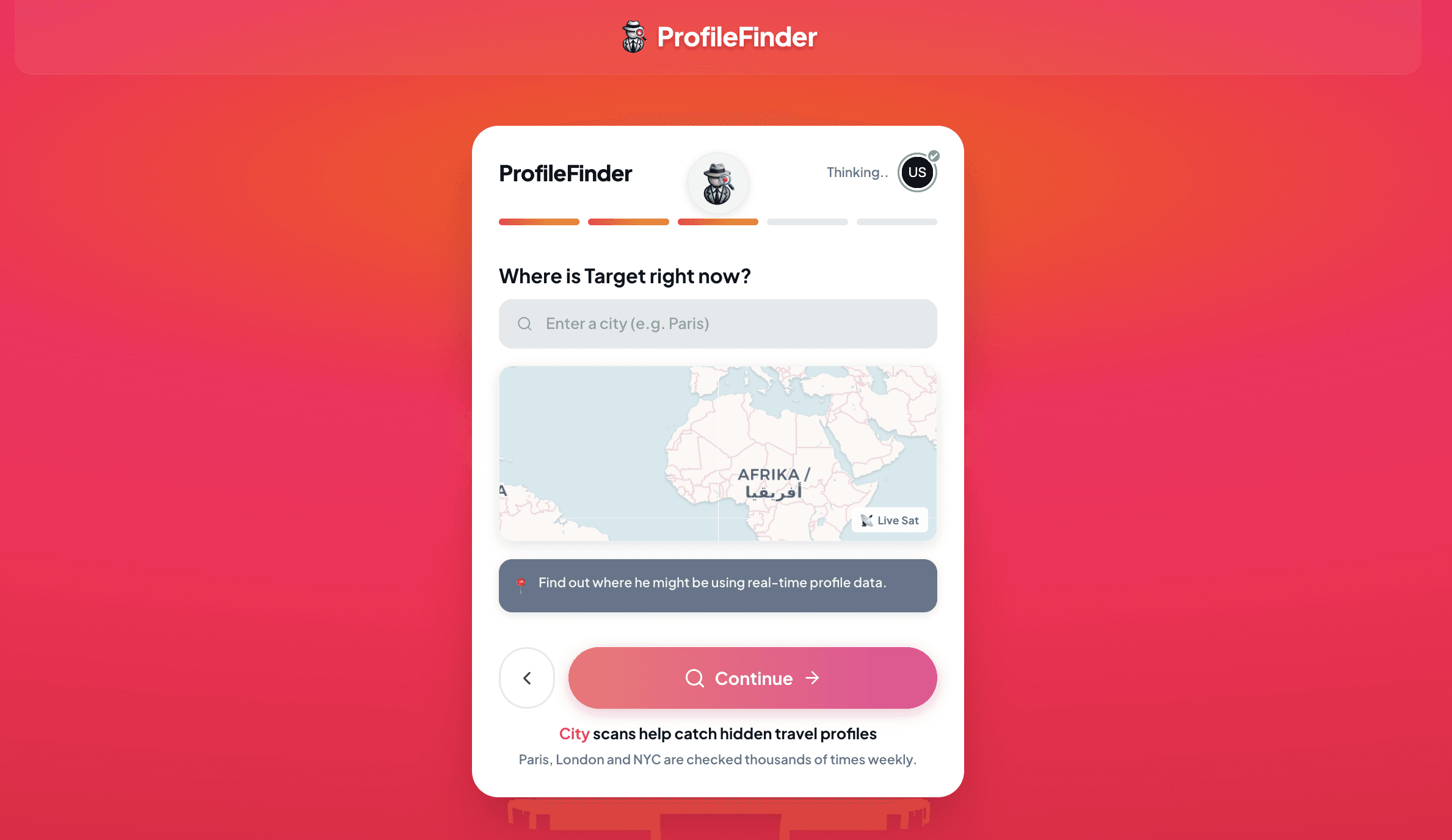
Step 4 — Choose the Most Relevant City
Use the city or area where the person is most likely to have used Tinder.
Location matters because Tinder's own Discovery system is geographically influenced.
If someone recently moved or traveled, consider that when evaluating results rather than forcing a match around an outdated location.
See Tinder's current Discovery Settings documentation.
Step 5 — Add a Photo When Appropriate
ProfileFinder's current search interface offers optional photo input.
If you choose to use it, use a clear and reasonably recent image.
Photo similarity should still be combined with age, location and recognizable profile information.
Step 6 — Review Possible Matches
Look beyond the first name.
Compare:
profile photos;
approximate age;
city or distance;
bio information;
recognizable interests;
other profile details you already know;
clearly labelled activity information.
A strong result is a combination of signals, not one matching field.
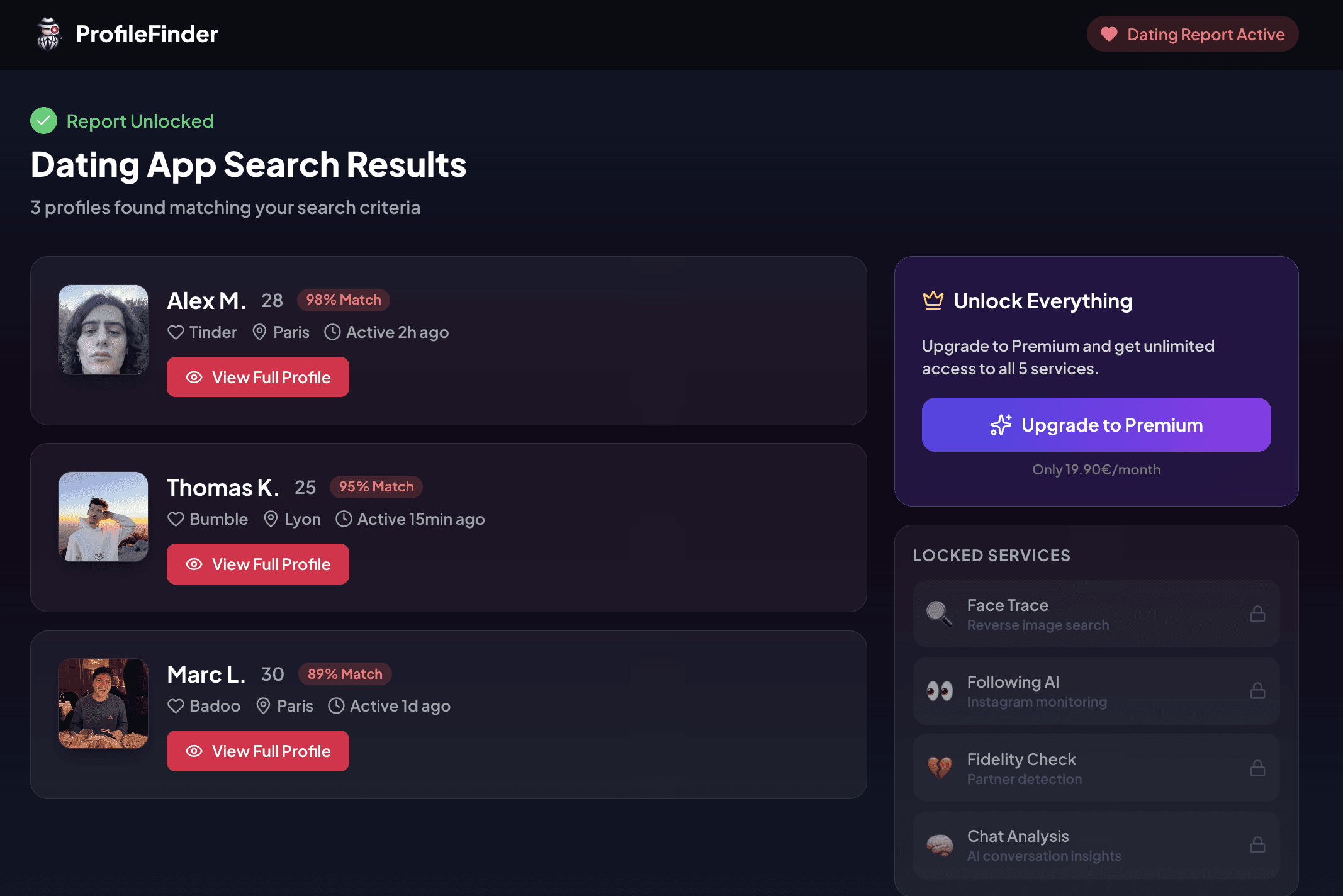
Step 7 — Compare the ProfileFinder and Cheaterbuster Results
Now compare both searches.
If they point toward the same identifiable person and the visible details are consistent, you have stronger corroborating information.
If the results disagree, do not simply choose whichever one confirms your suspicion.
The disagreement means more verification is needed.
What a Cross-Check Can — and Cannot — Do
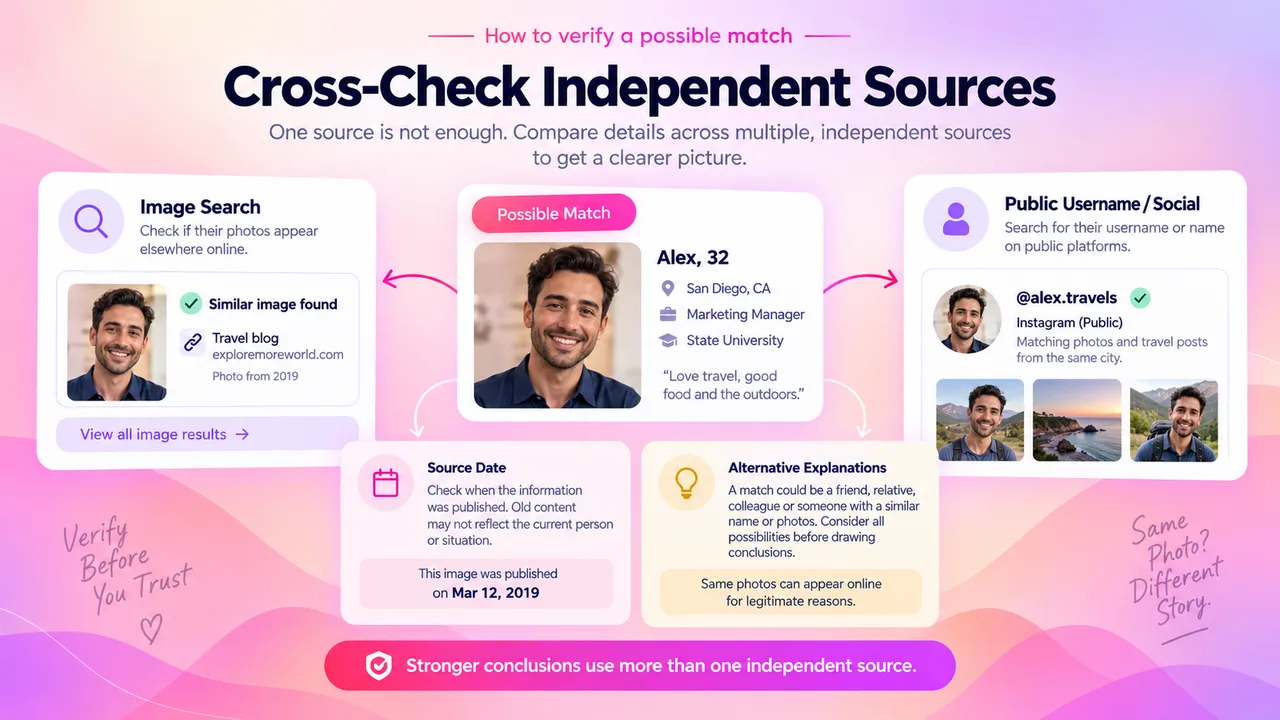
Two consistent searches are more useful than one ambiguous result.
But even then:
Two matches do not automatically prove cheating.
The purpose of cross-checking is to reduce identity uncertainty, not to manufacture certainty about someone's behavior.
For more methods specifically related to Tinder, see our Tinder profile lookup guide.
How Accurate Is Cheaterbuster?
There is no responsible universal percentage we can give you.
Cheaterbuster says its AI-powered search is “highly accurate” and that it combines signals such as photos, names and locations.
That is a first-party product claim.
The public Cheaterbuster pages reviewed for this article do not provide enough independent methodology to turn that statement into a defensible universal percentage.
So claims such as:
“Cheaterbuster is 63% accurate.”
or
“Cheaterbuster works 99% of the time.”
should not be treated as established facts unless the source provides a meaningful methodology.
For an accuracy percentage to tell you much, you would need to know:
sample size;
how test subjects were selected;
whether the true account status was known;
how false positives were measured;
how false negatives were measured;
what locations and account types were included;
when testing occurred;
whether the test was independent.
A small collection of successful searches is not enough to establish a universal accuracy rate.
Judge the Individual Match Instead
Signal |
Verification value |
|---|---|
Same first name |
Weak alone |
Same approximate age |
Helpful |
Same city |
Helpful but not unique |
Recognizable current photos |
Stronger |
Matching bio, school, job or interests |
Stronger |
Several details matching together |
Much stronger |
Similar result from a separate search workflow |
Stronger still |
The question should become:
How much independent information supports this specific match?
Not:
What accuracy percentage did a marketing page or random blog assign to the entire service?
What Does “No Match Found” on Cheaterbuster Mean?
A negative result is harder to interpret than a strong positive match.
If Cheaterbuster returns nothing, the safest conclusion is:
This search did not return a suitable match.
It is not:
“This person definitely has no Tinder or dating profile.”
There are several reasons a search can be inconclusive.
The entered location could be wrong.
The person could use a different name.
The account could be hidden from normal discovery.
The profile information could have changed.
Or there may genuinely be no relevant profile.
The result alone cannot tell you which explanation is correct.
Tinder Lets Users Hide Their Profiles
Tinder's official Help Center says users can disable Discovery without deleting their account.
When Discovery is disabled, the profile is not shown as a recommendation to new users, although existing matches remain available and people previously liked may still be able to see the profile.
Current Tinder subscriptions also include Incognito functionality that allows subscribers to hide their profile.
Exactly how those controls affect every third-party search service is not publicly documented.
So we should not pretend to know.
What the official Tinder documentation does establish is that:
Account existence and ordinary profile visibility are not the same thing.
Read: Tinder Help — Hide Your Tinder Profile

Can You Search for a Specific Person Directly on Tinder in 2026?
This is another area where older guides have become outdated.
Tinder introduced a Search feature that is being tested in some regions on iOS.
However, Tinder's 2026 documentation says this search is designed around keywords and interests — such as music, pets or travel — and is not designed to find one specific person.
So the old statement:
“Tinder has absolutely no search feature.”
is now too broad.
A more accurate 2026 answer is:
Tinder is testing a search feature, but it is not a public people directory or direct name lookup for finding a specific individual.
That is why third-party profile-search methods still exist.
For a deeper explanation, see Can You Search People on Tinder?.
Existing Profile vs. Active Profile: Why the Difference Matters
Finding a Tinder profile does not automatically tell you whether someone is actively using Tinder today.
Tinder explicitly distinguishes between hiding an account and deleting one.
Turning off Discovery can hide the profile while preserving the account and existing matches.
Deleting the Tinder app from a phone also does not delete the account.
See Tinder's official Delete Your Tinder Account documentation.
What you find |
Reasonable interpretation |
What remains uncertain |
|---|---|---|
Profile exists |
An account/profile exists or existed |
Whether it is currently used |
Photos and details match |
Identity becomes more likely |
Recency |
Profile has a clearly dated recent change |
Recent profile activity becomes more plausible |
Why the activity occurred |
No current activity visible |
You do not have evidence of recent activity |
Whether activity is hidden or absent |
No profile found |
Search was inconclusive |
Whether an account exists elsewhere |
This distinction prevents both false accusations and false reassurance.
What Does “Recently Active” Mean on Tinder?
Tinder has its own definition.
As of September 2026, Tinder says the green Recently Active dot indicates that a potential match has been online within the previous 24 hours.
But Tinder also allows users to turn that status off.
So:
No green dot ≠ proof of inactivity.
Likewise, if Cheaterbuster or another third-party service displays an “active” label, check how that service defines the signal.
Do not automatically assume it is identical to Tinder's official Recently Active status.
Read: Tinder Help — Recently Active
What Can a Cheaterbuster Result Actually Prove?
Search result |
What it may support |
What it does not prove |
|---|---|---|
Same name and city |
Search criteria overlap |
Identity |
Matching name, age and recognizable photo |
Identity becomes more plausible |
Current use |
Multiple personal details match |
Stronger identity evidence |
Recent dating behavior |
Verified profile + clearly defined recent change |
Recent account activity becomes more plausible |
Why the account was used |
Profile exists |
Account/profile may exist |
Cheating |
No result |
Nothing conclusive was returned |
No dating profile exists |
If you remember only one thing from this guide, remember this:
Possible match ≠ confirmed identity ≠ current activity ≠ proof of cheating.
Cheaterbuster Pricing in 2026
Cheaterbuster's current homepage advertises a search price of $19.99 + tax.
Its current FAQ adds an important detail: current plans operate as subscriptions with weekly updates for active searches, and a search subscription covers one person.
That makes older articles describing Cheaterbuster simply as a $17.99 one-time search outdated.
Before purchasing, check:
the current checkout amount;
whether the charge is recurring;
what monitoring is included;
how cancellation works;
whether additional people require another subscription.
Pricing and subscription terms can change, so the live checkout page should take priority over any third-party article — including this one.
For the broader legitimacy and billing question, read our Is Cheaterbuster Legit? guide.

Cheaterbuster vs. ProfileFinder.ai: What Is Actually Different?
Because ProfileFinder publishes this article, this comparison deliberately avoids declaring a winner.
It is based only on current publicly verifiable product information.
Feature |
Cheaterbuster |
ProfileFinder.ai |
|---|---|---|
First-name input |
Yes |
Yes |
Approximate age |
Yes |
Yes |
Location input |
Yes |
Yes |
Optional photo/face input |
Yes |
Yes |
Profile match review |
Yes |
Yes |
Activity-related information |
Described on current product pages |
Described on current Dating Search page |
Ongoing monitoring |
Weekly monitoring described in current FAQ |
Not presented as a separate active monitoring product on the current homepage |
Current positioning |
Broader profile/social/public-record search |
Focused Dating Search, currently centered on Tinder profile lookup |
Full public list of every covered dating app |
Not clearly published on pages reviewed |
Current homepage focuses primarily on Tinder |
Independently validated universal accuracy percentage |
Not established here |
Not established here |
Cheaterbuster source: How It Works
ProfileFinder source: ProfileFinder.ai
The practical reason to use ProfileFinder after Cheaterbuster is therefore not:
“ProfileFinder proves Cheaterbuster wrong.”
It is:
“A separate Tinder-focused search can give you another set of details to compare.”
That is a much more useful form of verification.
Does Cheaterbuster Search Tinder Only?
Not according to the way the company currently describes itself.
Cheaterbuster's current pages describe dating-app search alongside public-profile, social, photo and public-record signals.
However, the pages reviewed for this article do not provide an exhaustive current list of every dating app included.
So both of these statements go too far:
“Cheaterbuster only searches Tinder.”
and:
“Cheaterbuster searches every dating app.”
The evidence supports neither universal claim.
If your question is specifically about Tinder, use a Tinder-focused method and evaluate the result accordingly.
Common Mistakes When Using Cheaterbuster
Mistake 1: Treating a Name Match as Identity Confirmation
A common first name in a major city can match many people.
Look for several independent details.
Mistake 2: Treating “No Result” as Proof
A negative search means the search was inconclusive.
It does not prove an account does not exist.
Mistake 3: Confusing Account Existence With Current Activity
Tinder lets people hide profiles without deleting their accounts.
Mistake 4: Assuming an “Active” Label Means the Same Thing Everywhere
Tinder defines Recently Active as online within 24 hours, but users can hide that status.
Third-party services may define activity differently.
Mistake 5: Using an Outdated Review
Cheaterbuster's product has changed.
Current pages now mention face input, monitoring and broader public-profile signals.
Mistake 6: Believing a Precise Accuracy Percentage Without Methodology
A number is not evidence simply because it contains a percentage sign.
Ask how the figure was measured.
A Better Dating-Profile Verification Checklist
Identity
Does the face clearly match?
Is the age plausible?
Does the city make sense?
Do the bio, work, education or interests align?
Are there several matching details rather than only one?
Recency
Is there a specific date attached to the activity?
Is the activity signal clearly defined?
Has a visible photo or bio changed?
Could the profile predate the relationship?
Could the account simply be hidden rather than deleted?
Cross-Checking
Does a separate search return the same identifiable person?
Do the profile details agree?
Are there major contradictions?
Could this be somebody else with similar details?
Context
What does the evidence actually establish?
Is the relationship exclusive?
Is the timeline relevant?
Are you interpreting an account's existence as more than the evidence supports?

What If the Profile Itself Looks Fake?
Sometimes the issue is not suspected infidelity.
It is identity.
If a dating profile appears to use someone else's photos, the U.S. Federal Trade Commission recommends a reverse image search as one method for investigating a suspected romance scam.
The FTC also warns about common romance-scam patterns such as someone who repeatedly cannot meet in person and eventually asks for money.
If money or financial requests are involved, stop treating the situation as only a dating-profile question.
It may require fraud precautions.
Read: FTC Consumer Advice — What to Know About Romance Scams
Privacy and Responsible Use
Use dating-profile search tools only for lawful verification.
Do not attempt to obtain:
private messages;
passwords;
private account access;
someone's device data;
hidden photos;
location tracking.
Cheaterbuster says its current service aggregates publicly available information and does not hack accounts, collect private account data or provide real-time device tracking.
ProfileFinder's current public product is similarly presented as a profile-search workflow based on identifying information entered by the searcher.
Whatever tool you use, a search result should help you verify information, not justify invading someone's private accounts.
Frequently Asked Questions
Does Cheaterbuster actually work?
Cheaterbuster is an active profile-search service and can return possible matches, profile details and change/activity-related signals. Whether a specific search succeeds depends on the information entered and what data the service can surface. A significant result should still be verified against multiple identifying details.
How accurate is Cheaterbuster?
Cheaterbuster describes its AI-powered search as highly accurate, but the public pages reviewed for this article do not provide enough independent methodology to justify a universal accuracy percentage. Evaluate the quality of the individual match rather than relying on unsupported figures.
Does Cheaterbuster AI work?
Cheaterbuster currently markets its search as AI-powered and says it combines multiple identifying signals. “AI-powered,” however, does not remove the need to confirm identity, recency and context.
Does Cheaterbuster still only search Tinder?
Its current website describes a broader system involving dating-app search, public profiles, photos, social signals and public records. However, the public documentation reviewed here does not list every dating app searched.
Does Cheaterbuster use facial recognition?
Cheaterbuster's current How It Works page offers optional face input, and its FAQ says a search subscription can include facial-recognition search.
Does Cheaterbuster monitor profiles?
Its current documentation says active searches can receive weekly monitoring and profile-change updates. That is not the same as real-time device tracking.
What does “no result” on Cheaterbuster mean?
It means that search did not return a suitable match. It does not prove that the person has no Tinder or dating account.
Can someone hide their Tinder profile?
Yes. Tinder allows users to disable Discovery without deleting their account, and current Tinder subscriptions include an Incognito feature.
Can someone hide their Tinder activity status?
Yes. Tinder allows users to disable their Recently Active status in Settings.
What does Tinder's green dot mean?
Tinder says the green Recently Active dot indicates that the person has been online within the last 24 hours. Users can turn this indicator off.
Does deleting the Tinder app delete your profile?
No. Tinder says uninstalling the app does not delete the account. Account deletion must be completed separately through Tinder's settings or account-management process.
Can you search for a specific person on Tinder in 2026?
Tinder is testing a Search feature in some regions, but its official documentation says that feature is designed to search interests and keywords rather than find one specific person.
How much does Cheaterbuster cost in 2026?
As of this September 2026 update, Cheaterbuster's homepage displays $19.99 + tax. Its FAQ describes current plans as subscriptions with weekly updates for active searches. Check the live checkout page because pricing can change.
Does Cheaterbuster notify the person you search?
Cheaterbuster currently says searches are anonymous and are run from public-record/public-profile information. This is Cheaterbuster's own description of its service.
Can Cheaterbuster prove someone is cheating?
No profile-search tool can determine the full context of a relationship. A verified and recently active dating profile may be relevant evidence, but identity, activity and relationship boundaries still need to be considered separately.
How do I verify a Cheaterbuster match?
Compare multiple identifiers such as photos, age, location and recognizable profile details.
Then, if the result matters, compare it against another search source rather than depending on a single algorithm. ProfileFinder.ai can be used for a separate Tinder-focused search.
Related Readings
Is Cheaterbuster Legit? — legitimacy, billing and trust.
Cheaterbuster AI Review — broader product overview.
Tinder Profile Lookup — methods for investigating a possible Tinder profile.
How to Find Out If Someone Is on Tinder — broader Tinder verification guide.
Can You Search People on Tinder? — Tinder search limitations and third-party approaches.
How to Search People on Tinder — practical targeted Tinder search methods.
Sources & Editorial Methodology
This article was updated using current product documentation available on September 21, 2026.
For Cheaterbuster features and pricing, we use Cheaterbuster's current first-party homepage, FAQ and How It Works documentation rather than relying on old reviews.
For Tinder visibility, activity status, account deletion and Tinder's Search feature, we use Tinder's official Help Center.
For fraud and fake-profile safety advice, we use U.S. Federal Trade Commission consumer guidance.
ProfileFinder functionality is described only where supported by ProfileFinder's current live Dating Search page.
We did not conduct a controlled accuracy test of Cheaterbuster for this article.
For that reason, this article does not claim that Cheaterbuster — or ProfileFinder — has a specific independently proven accuracy percentage.
This article should be rechecked whenever Cheaterbuster, ProfileFinder or Tinder materially changes its search, privacy or account functionality.
Primary Sources
Final Answer: Does Cheaterbuster Work?
Yes, Cheaterbuster can work as a profile-search tool. But “working” and “proving cheating” are not the same thing.
Cheaterbuster's current product is more capable than many older reviews suggest. Its official 2026 pages describe first-name, age and location search, optional face input, dating-app and public-profile analysis, activity/change signals and weekly monitoring.
But every result still needs interpretation.
Possible match ≠ confirmed identity.
Confirmed identity ≠ recent activity.
Recent activity ≠ proof of cheating.
And:
No result ≠ proof that no account exists.
If Cheaterbuster returns a result that matters, compare multiple identifying details and consider cross-checking the same basic information through a separate Tinder-focused search such as ProfileFinder.ai.
The goal is not to find the answer you expect.
It is to build enough reliable evidence to understand what the result actually means.