

Editorial Disclosure: This review is an independent technical analysis conducted by digital privacy and OSINT investigators. Our evaluations are grounded in reverse-engineering public dating app discovery endpoints, empirical search testing, and analyzing verified consumer feedback on Trustpilot and watchdog forums. ProfileFinder.ai operates a privacy-first multi-platform dating profile search engine and publishes comparative research to help consumers navigate online verification safely and ethically.
Quick Answer: Does Cheateye Work in 2026?
Yes, but with strict technical limitations and significant subscription risks. Cheateye (cheateye.ai) functions as an automated scraper querying public Tinder discovery endpoints using a first name, age, city GPS coordinates, and reference facial images. It cannot search Bumble, Hinge, or social media networks, nor can it detect accounts when Tinder's "Discovery" setting is toggled off. Furthermore, while single search credits are marketed between $5.99 and $17.90, users frequently report unexpected enrollment into a recurring monthly "Radar" subscription ($29.99+/month) with strict non-refundable terms, resulting in a ~1.5/5 Trustpilot rating. For multi-platform searches with transparent pricing, cross-platform search engines like ProfileFinder offer broader coverage without automated billing traps.
What Is Cheateye? Overview and Brand Positioning
Cheateye entered the relationship investigation and dating profile verification market positioning itself as an "AI-powered infidelity detection" tool. Primarily marketed toward individuals experiencing relationship doubts or attempting to verify whether a partner has an active dating profile, Cheateye advertises that it can locate hidden profiles using only basic demographic details and a photograph.
In practice, Cheateye is an automated wrapper that interfaces with public dating app APIs. Rather than deploying proprietary global facial recognition or monitoring private messaging, Cheateye focuses almost exclusively on querying Tinder's public discovery queue within simulated geographic coordinates. Understanding this technical distinction is crucial for setting realistic expectations about what the tool can and cannot achieve.
How Cheateye Works: Technical Architecture and the Radar Trap
To evaluate Cheateye objectively, it is helpful to look under the hood at its operational workflow. When an investigation request is submitted through Cheateye's web interface, the platform executes a 4-step pipeline:
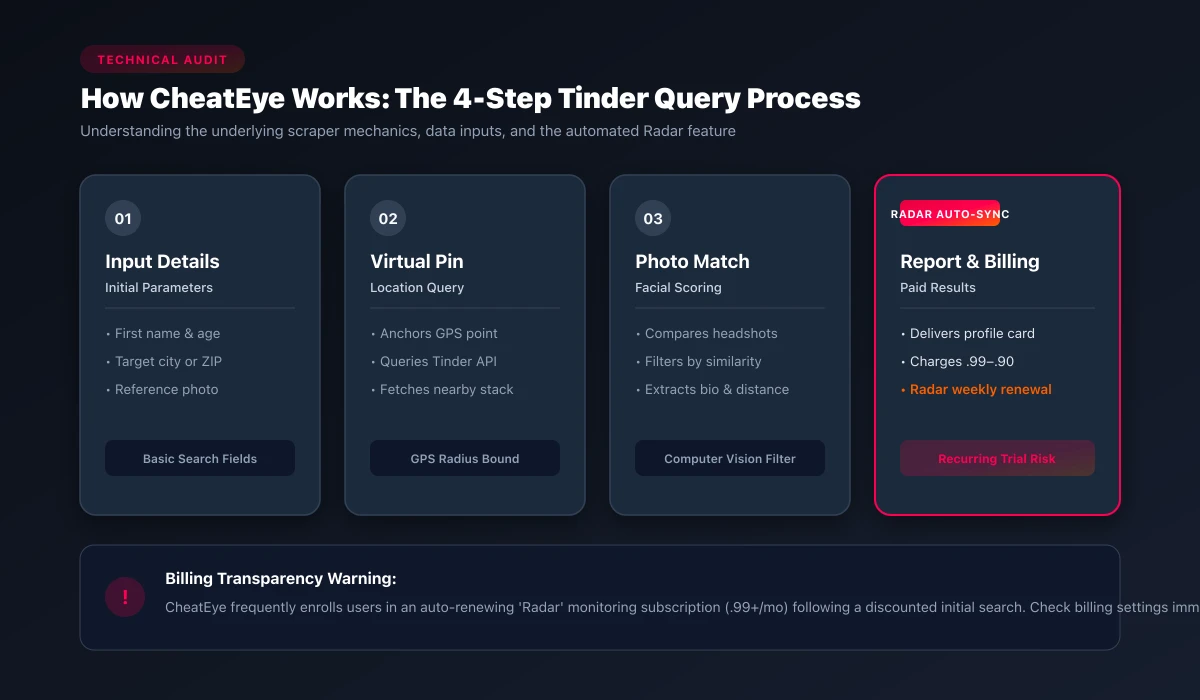
Step 1: User Input Collection
The user provides the target's first name, estimated age, city or geographic area, and an optional reference photo. These parameters serve as the primary query filters for downstream API scripts.
Step 2: Virtual GPS Pinning and Swiping Simulation
Cheateye scripts automated requests simulating a Tinder user located at the specified city coordinates. The system queries Tinder's public discovery API, cycling through profile cards within the specified age bracket and geographic radius.
Step 3: Facial Vector Comparison
When public profile cards matching the name and age range are returned, an automated computer vision algorithm compares facial landmarks from the uploaded reference picture against the dating profile photos. A similarity confidence score is calculated to identify potential matches.
Step 4: Paywalled Report Delivery and the Radar Auto-Sync Warning
Once a candidate profile is identified, the user is presented with a heavily blurred preview. To reveal the unblurred photos, full bio, and timestamp information, the user must purchase a report credit. Crucially, during the payment flow, users are frequently opted into "Radar"—an automated recurring monitoring feature that bills their credit card on a monthly cycle (often $29.99/month) to periodically rescan Tinder discovery queues.
Cheateye Pricing, Radar Subscription and Trustpilot Review Patterns
Understanding Cheateye's true cost requires reading beyond the initial landing page claims. While an entry-level single search credit is promoted around $5.99 to $17.90 depending on processing speed and depth, customer satisfaction scores tell a complex story.
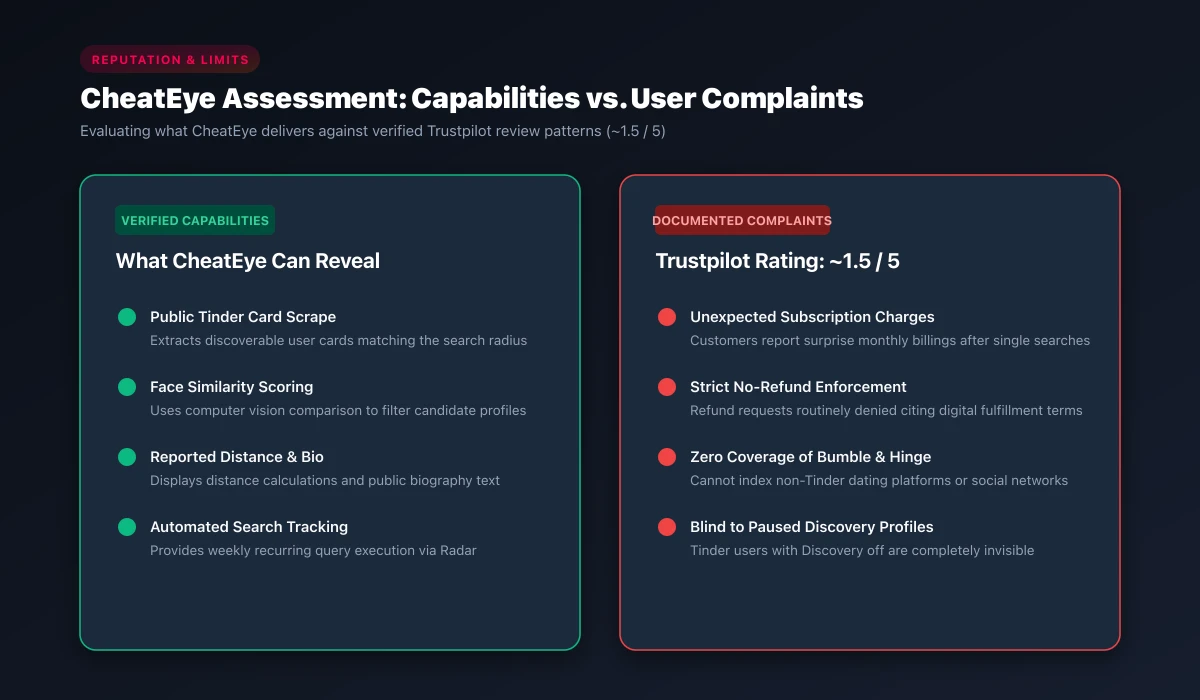
On independent review platforms such as Trustpilot, Cheateye holds an aggregate rating hovering around 1.5 out of 5 stars. An analysis of verified consumer complaints reveals several recurring patterns:
- Surprise Radar Recurring Charges: Numerous customers report purchasing what they believed was a one-time single search, only to discover recurring monthly charges of $29.99 or higher on subsequent bank statements.
- Strict No-Refund Policies: According to user reports and terms of service analysis, Cheateye enforces strict non-refundable terms, even when automated searches fail to return any matching data or produce obvious false positives.
- Customer Support Friction: Users reporting unauthorized rebilling frequently note significant friction when attempting to cancel memberships or communicate with support agents, with many resorting to bank chargebacks or cancelling cards.
- False Positives and Stale Matches: Due to basic facial matching and reliance on public Tinder caches, users have received alerts for individuals who shared similar features or whose accounts had been dormant for months or years.
Key Technical Limitations and Blindspots of Cheateye
Beyond billing considerations, Cheateye possesses fundamental architectural limitations that every user should understand before paying for a search:
1. Single-Platform Dependency (Tinder Only)
Cheateye's core scraping architecture is engineered specifically for Tinder discovery endpoints. It does not monitor or index other major platforms such as Bumble, Hinge, Badoo, Match, or Plenty of Fish. If the person you are searching uses alternative dating platforms, Cheateye will return zero results.
2. The "Discovery Off" & Incognito Blindspot
Tinder features a privacy setting called "Show me on Tinder" (or Incognito mode for premium subscribers). If an individual turns off Discovery, their card is completely removed from the public swipe queue. Cheateye relies entirely on public queue scraping, meaning it has zero visibility into users who have paused their visibility or only show their profile to people they have swiped right on.
3. Strict Geographic Pinning Constraints
Tinder operates on device-level GPS radiuses. If you configure Cheateye with a home address, but the target primarily opens the app while commuting, traveling for business, or staying across town, the automated scanner may fail to query the correct geographic cluster, resulting in false negatives.
4. Cache Decks vs. Real-Time Activity
When an individual stops using Tinder without permanently deleting their profile, Tinder's servers often retain the card in local swipe decks for days or weeks. Cheateye cannot distinguish between someone actively swiping this morning and an abandoned, dormant profile that has not been opened in months. Assuming a match equals active infidelity is a major evidentiary flaw.
Feature Comparison: Cheateye vs. ProfileFinder
To help you determine which approach fits your verification needs, the following matrix compares Cheateye with ProfileFinder:
| Feature / Metric | Cheateye (cheateye.ai) | ProfileFinder (profilefinder.ai) |
|---|---|---|
| Supported Platforms | Tinder public discovery queue only | Multi-platform: Tinder, Bumble, Badoo, Hinge & more |
| Search Methodology | Automated GPS coordinate query + face similarity | Multi-parameter query: name, age, city & facial matching |
| Subscription Model | Single credit + recurring "Radar" auto-enrollment ($29.99/mo) | Transparent single searches or clearly managed plans |
| Billing Transparency | ~1.5/5 Trustpilot score due to unexpected rebills | No hidden subscription enrollments or surprise charges |
| Refund Policy | Strict no-refund policy reported by consumers | Transparent terms and dedicated customer support |
| Dating App Coverage | Single app (0% Bumble/Hinge visibility) | Comprehensive cross-platform dating coverage |
| Activity Analysis | Flags cached profiles as active; high false-positive risk | Evidence ladder framework to verify profile recency |
How to Search and Verify Dating Profiles Safely with ProfileFinder
If you need to verify whether a partner or acquaintance has an active profile across multiple dating platforms without risking subscription billing traps, ProfileFinder provides a transparent 4-step search workflow:
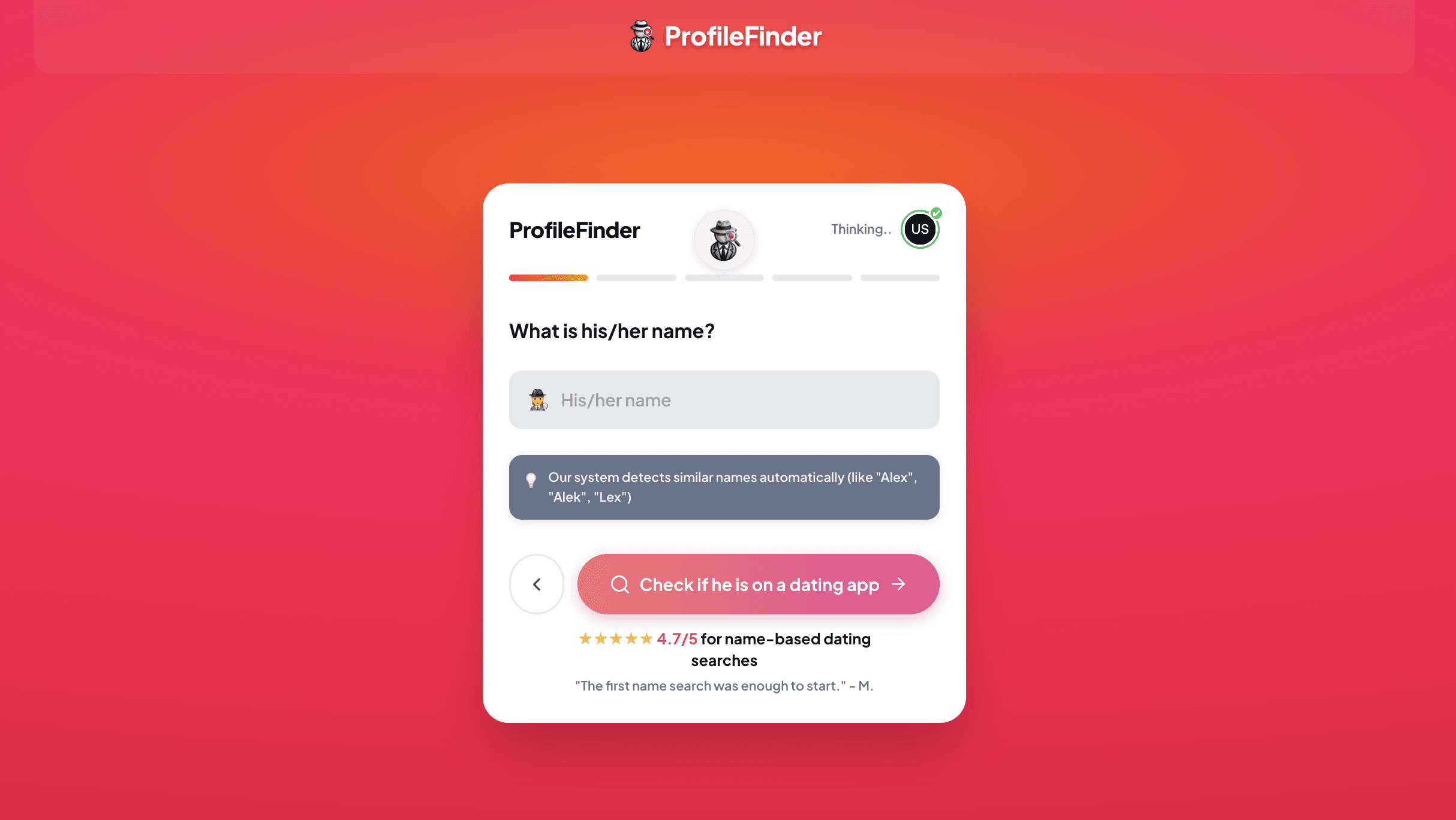
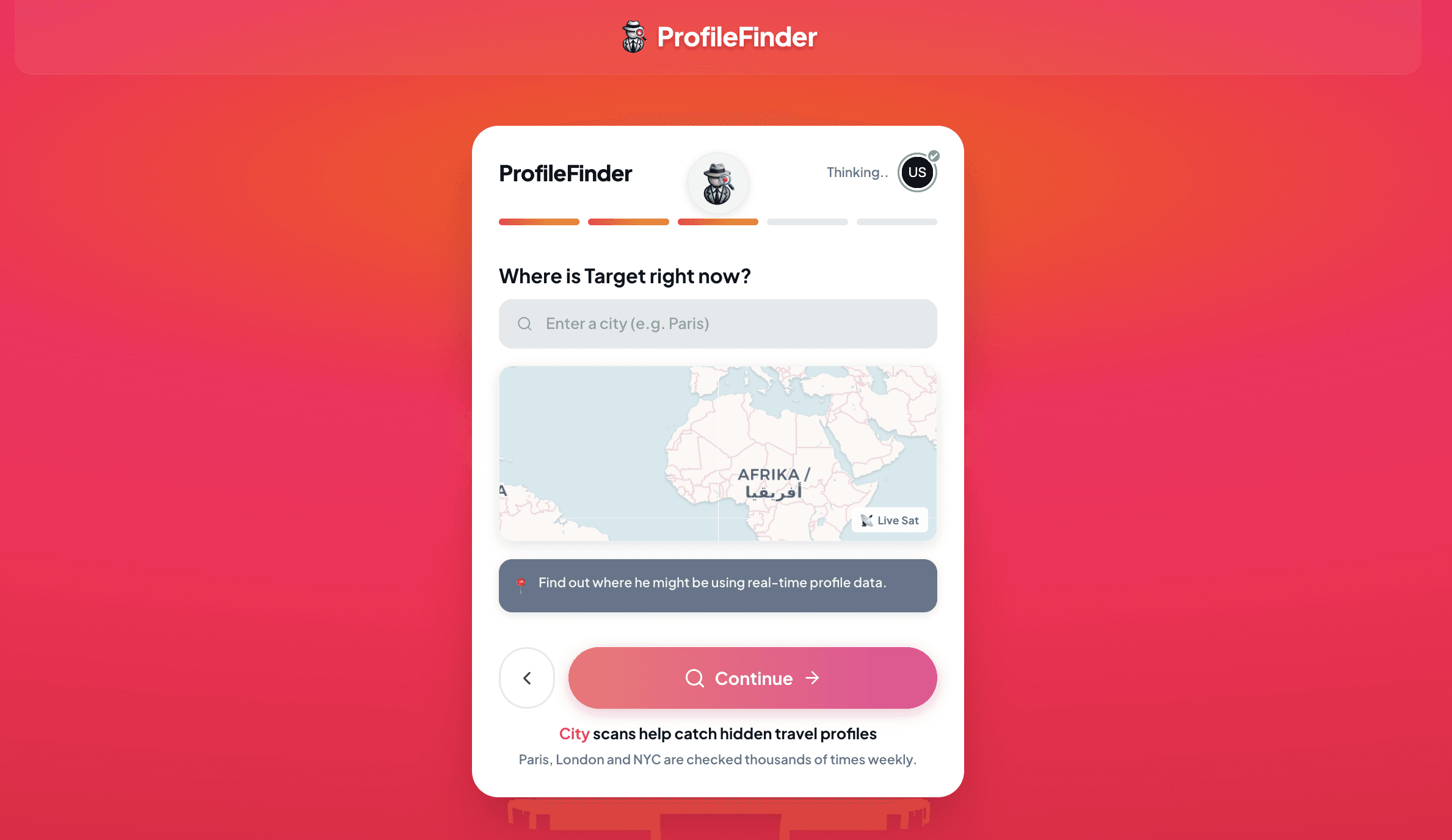
Step 1: Enter Demographic and Geographic Parameters
Begin by entering the individual's first name, estimated age range, and primary location. ProfileFinder's search interface allows you to refine geographic boundaries to account for home, work, and frequent travel zones.

Step 2: Multi-Platform Simultaneous Search
Unlike single-platform tools that only look at Tinder, ProfileFinder's proprietary search engine scans publicly accessible profile indexes across multiple major dating ecosystems simultaneously, including Tinder, Bumble, Badoo, and Hinge.
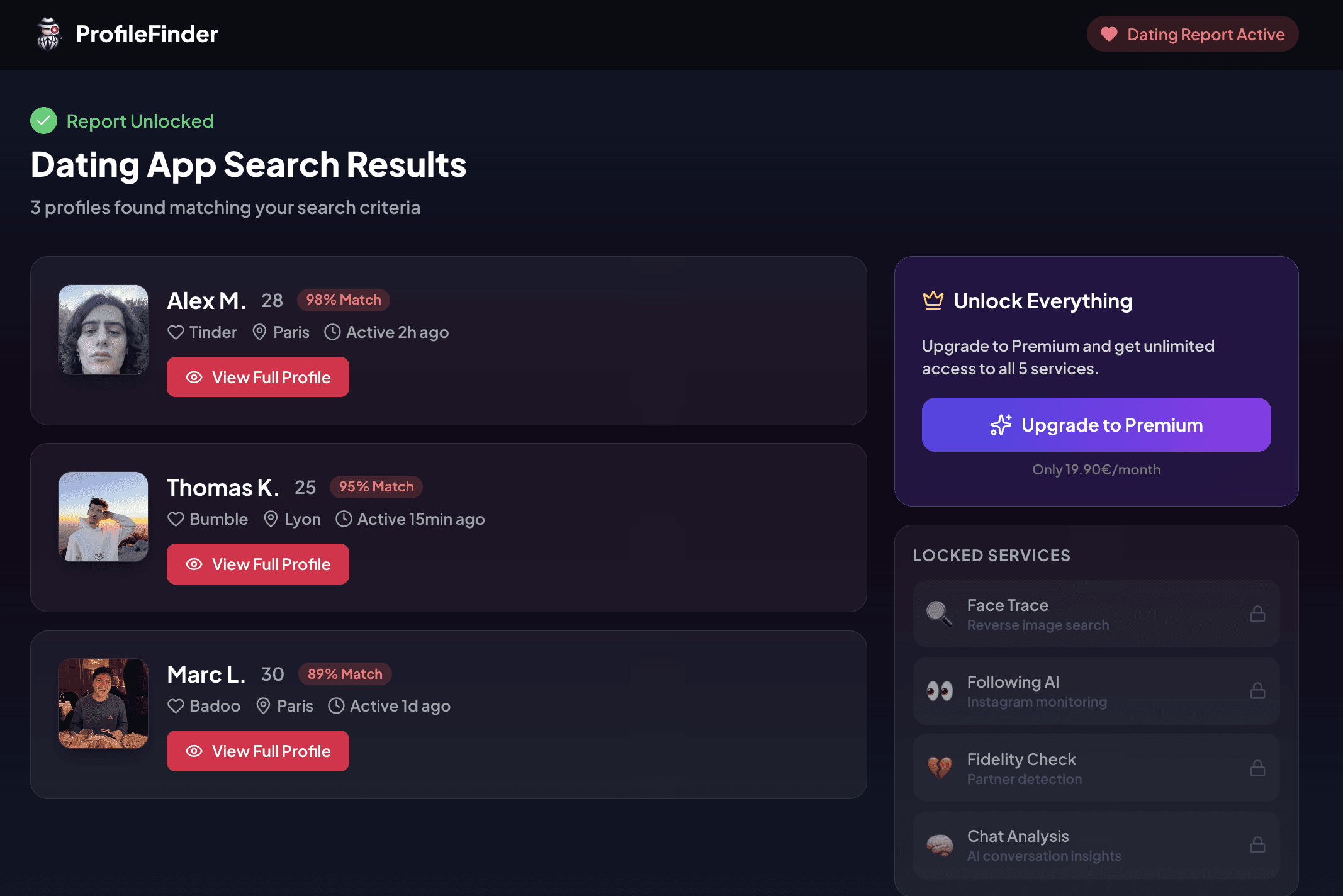
Step 3: Review Matched Profiles and Match Confidence
Search results present matched candidates with clear confidence metrics, comparing profile photos, stated ages, occupations, and geographic markers so you can evaluate candidate relevance systematically.
Step 4: Detailed Profile Inspection and Safe Verification
Review candidate bios, connected Instagram or Spotify integrations, and photo timestamps. This allows you to verify whether a profile is an authentic, current account or an outdated ghost profile from before a relationship began.
The 4-Stage Evidence Ladder: How to Interpret Results Responsibly
Discovering a dating profile during an online search can trigger intense emotional reactions. However, digital breadcrumbs require careful, rational interpretation. Automated tools cannot determine human intent, relationship agreements, or account creation dates on their own.
To avoid false accusations and preserve peace of mind, follow the 4-Stage Evidence Ladder before drawing conclusions:
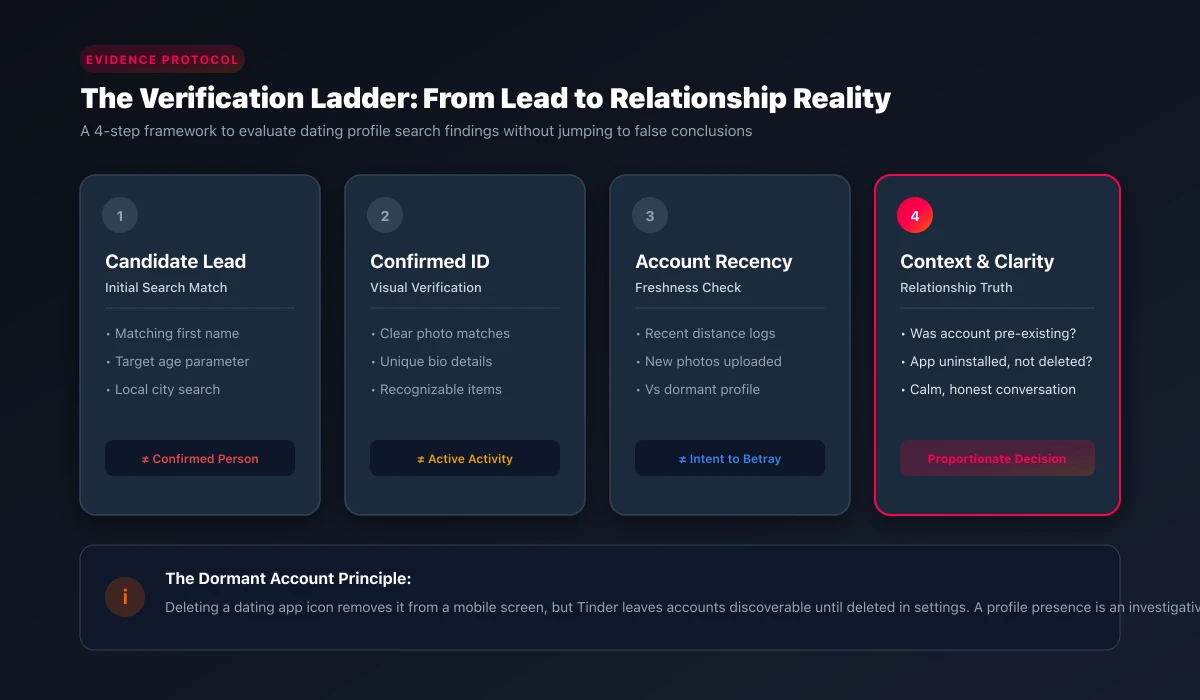
Stage 1: Public Lead (Low Certainty)
An automated query flags a profile card matching a common first name and age within 25 miles. At this stage, you have only a raw digital lead. In metropolitan areas, hundreds of individuals share identical names and age brackets.
Stage 2: Confirmed Identity (Medium Certainty)
Multiple profile photos distinctly match the person, verified through unique background locations, clothing, tattoos, or linked social media accounts. You have confirmed that the profile represents the individual in question.
Stage 3: Account Recency Verification (High Certainty)
Crucially, confirming identity does not confirm recent infidelity. You must verify whether the account is currently active. Clues include updated photos from recent months, references to recent events in the bio, or changed location markers. An account created four years ago that was simply deleted from the phone without deleting the underlying account remains dormant on server caches.
Stage 4: Dialogue and Resolution (Actionable Truth)
Digital evidence should never serve as a weapon for spontaneous confrontation. Present observed facts calmly and seek open communication. Often, dormant accounts, shared old devices, or prank profiles created by acquaintances explain digital anomalies far better than worst-case assumptions.
Frequently Asked Questions (FAQ)
Does Cheateye offer a free trial or free search?
No. Cheateye does not provide free full searches. While the initial landing page allows users to enter search parameters without upfront payment, the results and matching photos are blurred behind a paywall. Revealing the data requires purchasing credits, which frequently includes enrollment into the auto-renewing "Radar" subscription.
Can Cheateye detect deleted or hidden Tinder profiles?
No. Cheateye can only query profiles that Tinder's discovery algorithm serves to public users. If an account has been permanently deleted, banned, or hidden via the "Show me on Tinder" privacy toggle, Cheateye cannot detect it.
Does Cheateye notify the person being searched?
No. Searches conducted via Cheateye simulate external Tinder client requests and do not trigger push notifications, emails, or in-app alerts to the target account. However, all searches should be conducted responsibly and in accordance with privacy laws.
How do I cancel a Cheateye Radar subscription?
To cancel an active Cheateye subscription, check your original receipt email for customer support or account management links. If support does not respond promptly, many users report contacting their credit card issuer or bank to block recurring merchant charges from Cheateye.
Does Cheateye work on Bumble, Hinge, or Instagram?
No. Cheateye is exclusively focused on Tinder discovery queues. It does not possess indexing capabilities for Bumble, Hinge, Badoo, Grindr, or social media platforms.
Related Investigations and Free Verification Guides
Explore our research and comprehensive guides to dating app investigations, competitor evaluations, and privacy-first search techniques:
- Cheateye Free Alternatives: 5 Safe Ways to Check Profiles
- Cheatbuster AI Honest Review: Real Costs and Limitations
- Is Cheaterbuster Legit? Testing Tinder Accuracy in 2026
- Multi-Platform Dating Profile Search Engine
- Cheater Finder: Comprehensive Digital Lead Verification
Final Verdict: Should You Use Cheateye?
Cheateye offers a narrowly targeted mechanism for querying public Tinder discovery cards, but its single-platform scope, ~1.5/5 Trustpilot score, and frequent consumer reports of unexpected "Radar" subscription rebilling make it a risky choice for casual users. If your investigation requires multi-platform coverage across Bumble, Tinder, and Hinge with transparent, one-time pricing and no hidden subscription traps, ProfileFinder.ai provides a reliable, comprehensive alternative.