
When something feels off, it is tempting to look for one free search that settles everything. That does not exist. The useful goal is to gather lawful, public clues, understand their limits, and decide what deserves a calm conversation.
This guide explains how to catch a cheater free without spyware, fake accounts, or a rush to judgment. It focuses on dating-profile clues, image and username checks, and the difference between a possible match and reliable context.
⚡ Quick Answer
You can catch a cheater free only in the sense of finding public leads—not proving infidelity with a single search. Start with a reverse image search, public username research, and a dating-profile search using details you already know. A profile can be old, copied, hidden, or belong to someone with a similar name. Treat any result as a clue to cross-check, not a verdict.
The 7 privacy-respecting checks
- Write down verifiable details. Use only information you already know: a first name, approximate age, usual city, public usernames, and public photos.
- Search public usernames. Look for reused handles or bio phrases, then compare multiple details rather than a name alone.
- Use reverse image search. Check whether a public photo appears under another name or on an unexpected site.
- Search for possible dating profiles. Use a focused workflow when the question is specifically about dating apps.
- Account for platform visibility. A profile may be hidden, inactive, or outside the details you searched.
- Cross-check before interpreting. Compare photo, name, age, location, and timing; one match is not enough.
- Choose a safe next step. If something is concerning, decide whether a conversation, support from someone you trust, or more context is appropriate.
Skip anything that requires accessing another person's phone, account, messages, or location without permission. It can violate privacy, create legal risk, and still give you unreliable context.
How to Catch a Cheater Free With ProfileFinder
If your question is specifically whether someone may have a dating profile, a focused dating profile search is more useful than trying to browse every app manually. ProfileFinder is a search workflow for reviewing possible matches; it does not turn a name or photo alone into proof of identity or infidelity.
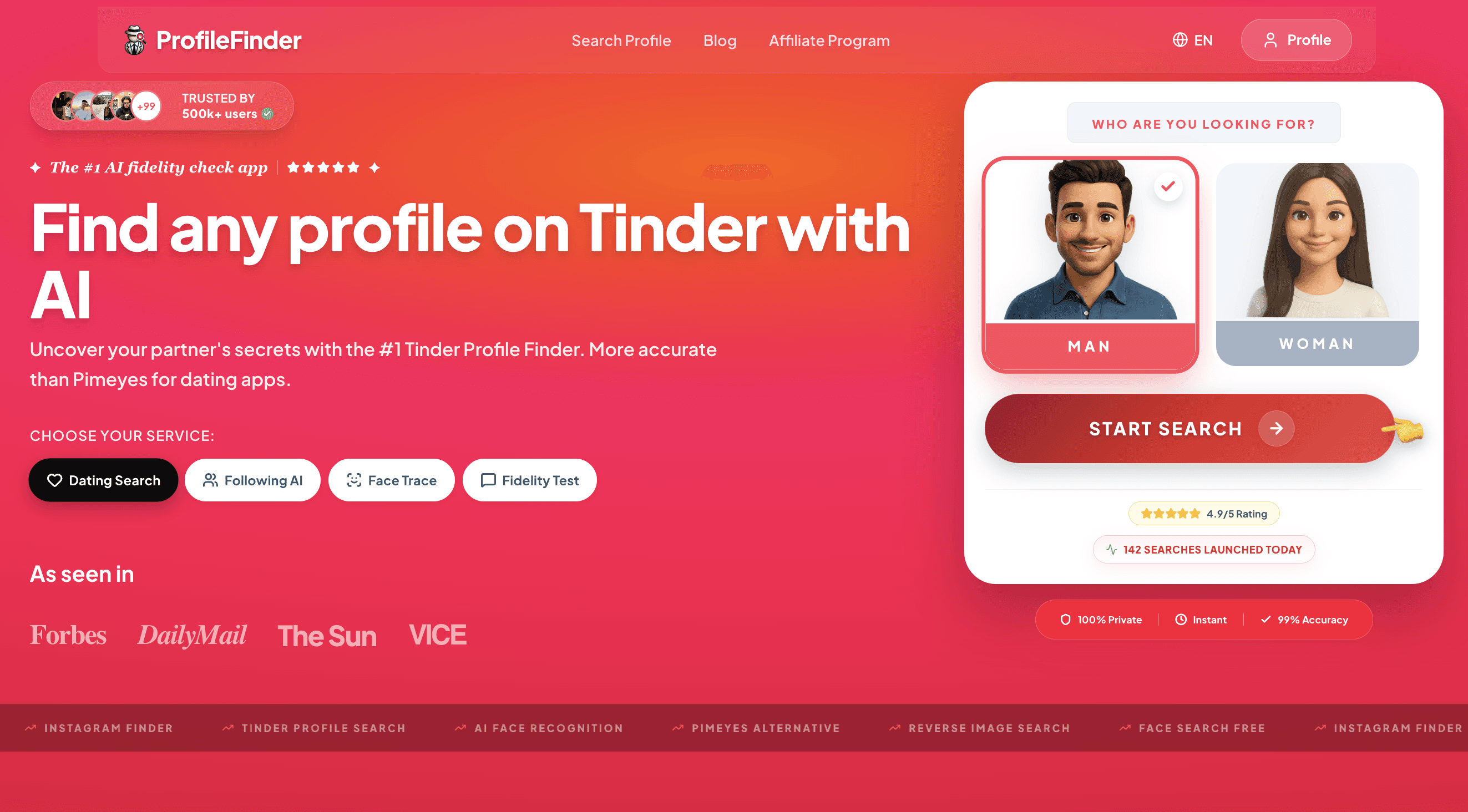
Step 1: Open ProfileFinder
Open the ProfileFinder dating search and choose the person category that matches the search. This starts the workflow without asking you to access the other person's account.
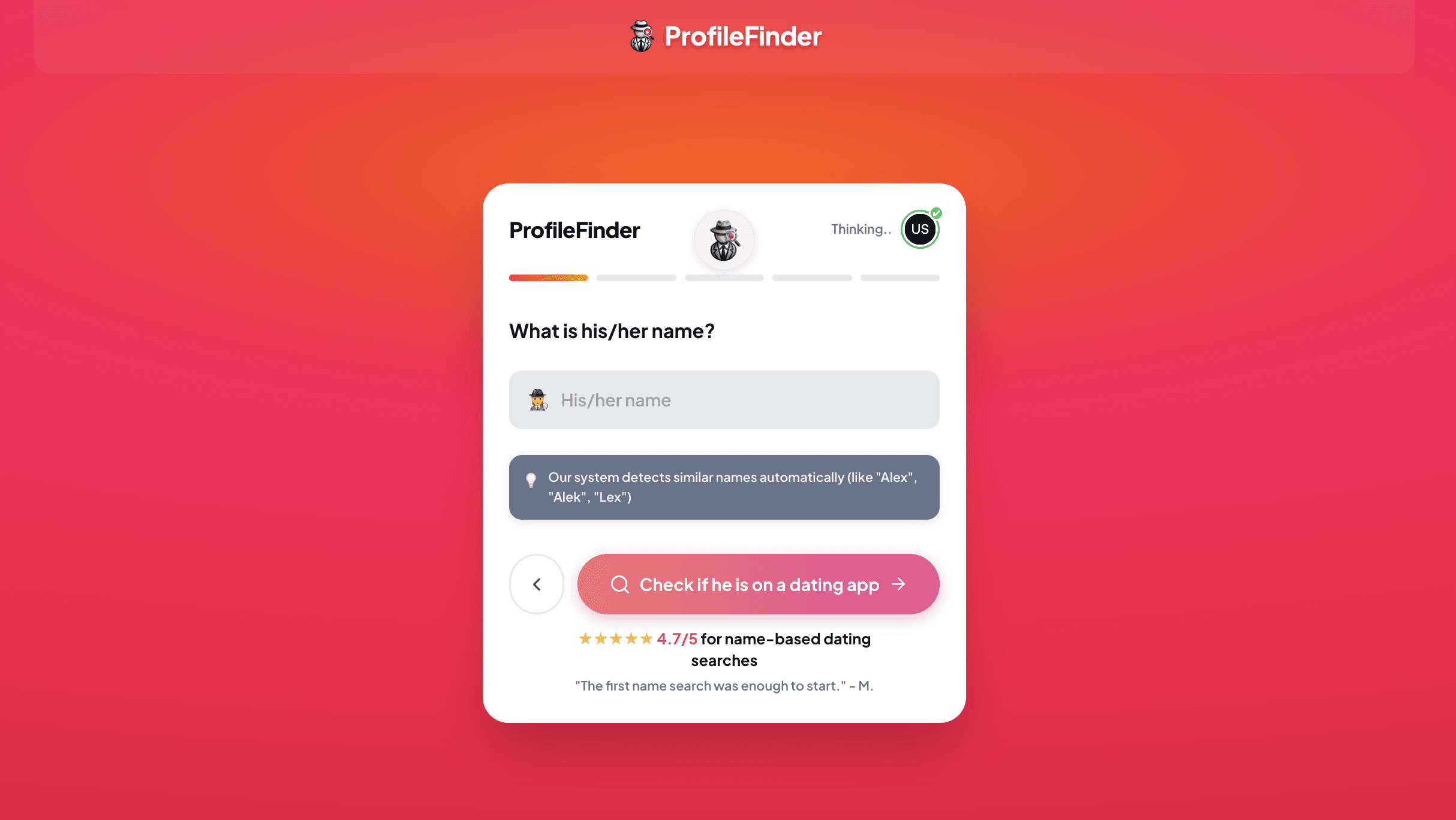
Step 2: Enter the first name you can verify
Add the first name the person actually uses. If a result later appears, a name is only one identifying detail—especially when it is common.
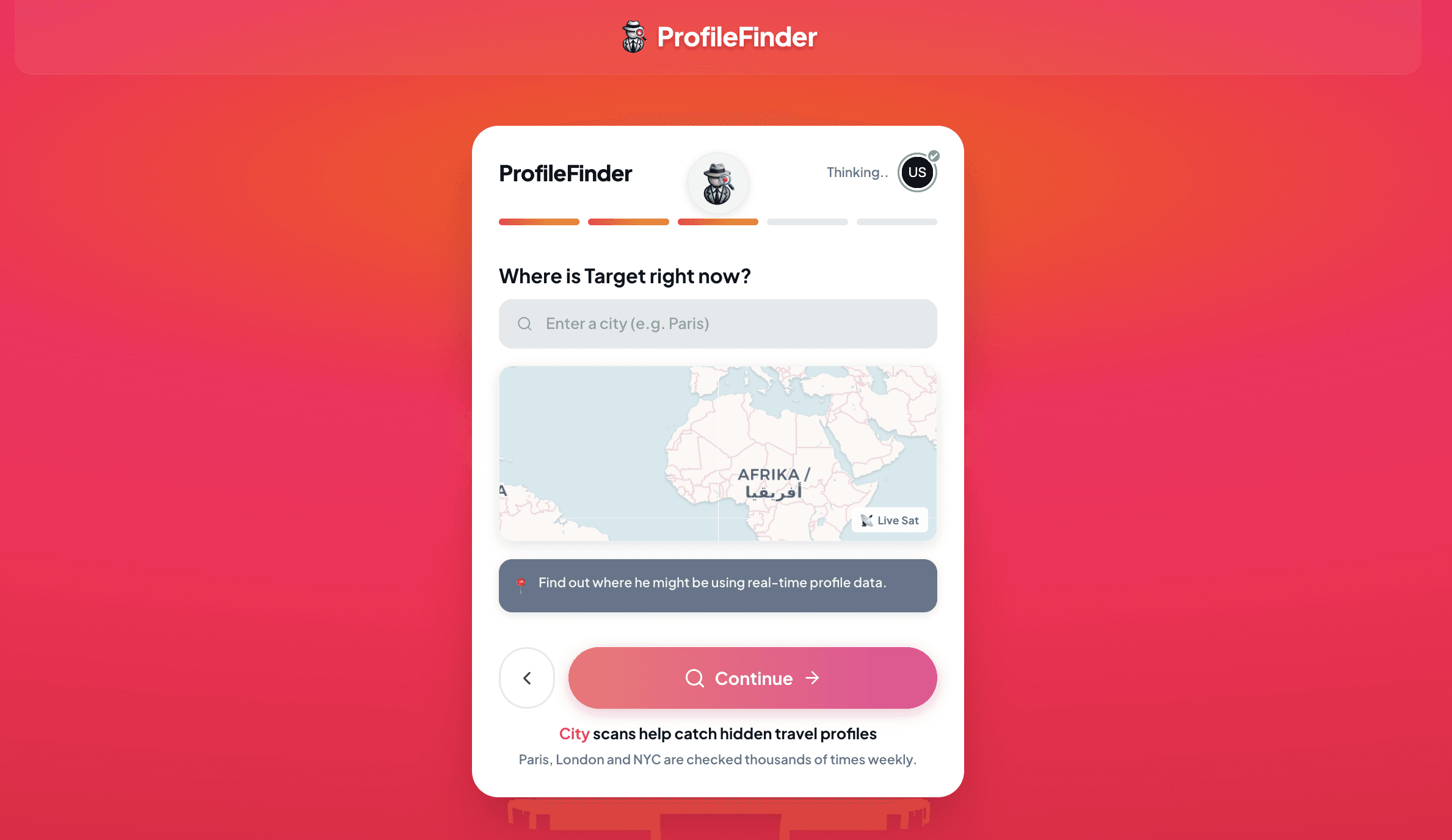
Step 3: Add an approximate age and location
Use an age and city or area you can reasonably verify. These details can help narrow possible matches, but they should never be treated as confirmation by themselves.
Step 4: Launch the search
Run the search after checking the details you entered. Search inputs narrow the candidates; they do not prove that a returned profile belongs to the person.
Step 5: Review possible matches and cross-check details
Review a possible match against several independent details you already know. Look for consistency in photo, name, age, location, and context. Do not assume that a card, image, or similar name establishes who controls an account or whether it is currently active.
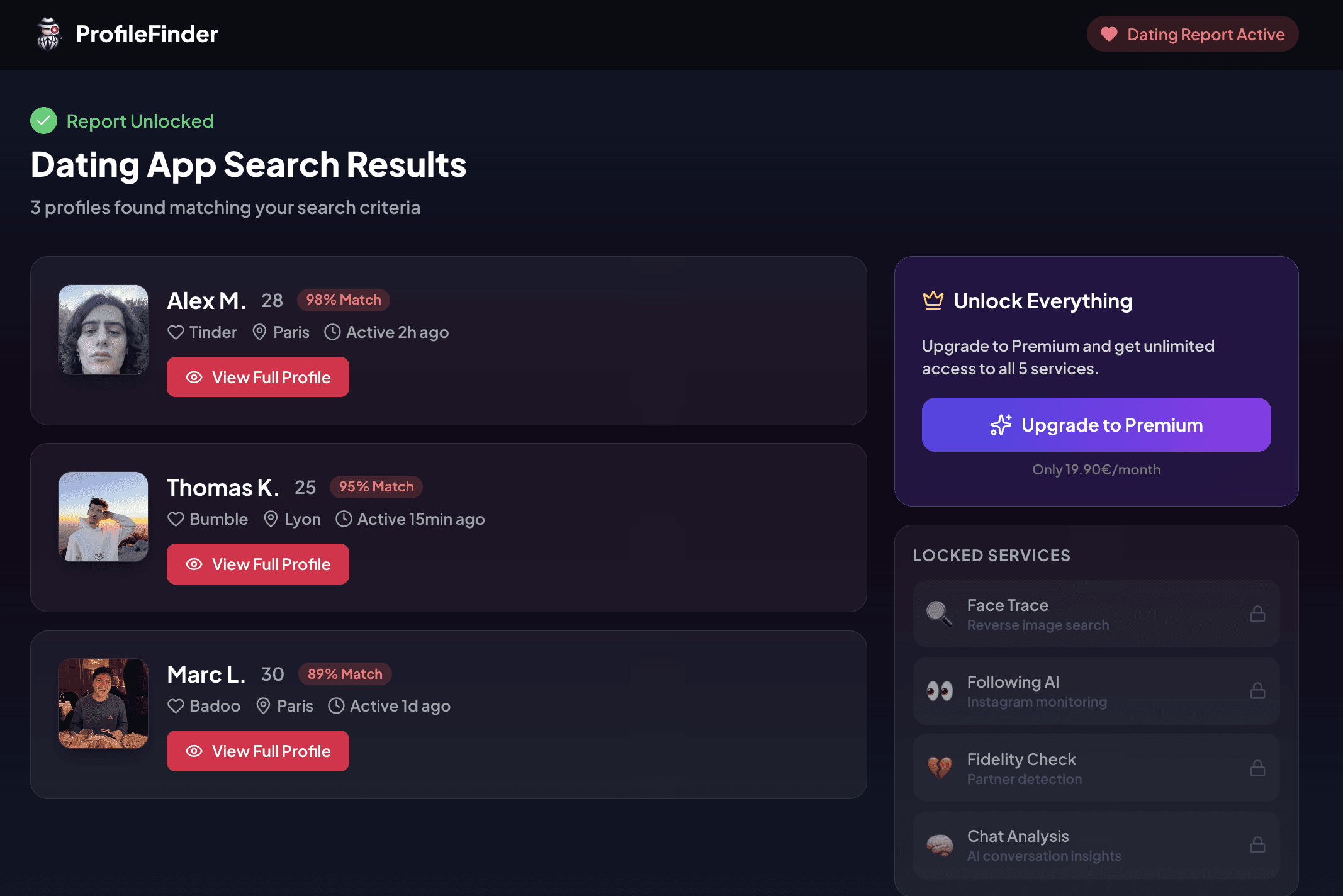
What a result can—and cannot—tell you
| Evidence level | What you have | What it supports | What it does not prove |
|---|---|---|---|
| Possible match | Similar name, photo, or location | A lead worth checking | Identity, current activity, or infidelity |
| Probable identity | Several public details line up | That the account may belong to the person | Who currently controls it or why it exists |
| Verified context | Reliable, independent context and an explanation | A basis for an informed conversation | A reason to make an accusation without care |
This evidence ladder is the key distinction many generic guides miss. A single online signal can be ambiguous. The more serious the decision, the more important it is to slow down and verify context.
Reverse image search: useful for inconsistencies, not certainty
Google explains how to search with an image using Google Lens. A reverse image search can reveal where the same or similar image appears online. It is useful when a photo appears with a different name, city, or story.
It can also miss profiles entirely. Images may be private, cropped, replaced, or never indexed. A match can be a repost or a stolen image. Use it as a way to ask better questions, not as a shortcut to a conclusion.
Tinder profile search: why a no-result is incomplete
There is no public Tinder directory that reliably answers whether a person has an account. Tinder says people can turn off Discovery so they are not shown to new recommendations without deleting the account. Read Tinder's guidance on hiding a profile before treating a search result—or a lack of one—as definitive.
For a narrower look at that question, see how to find out if someone is on Tinder. The practical rule is simple: a missing match is not proof that an account never existed, and a found profile still needs identity and timing checks.
Username and public social search
People sometimes reuse a username, a profile photo, or a distinctive phrase across public services. Search an exact username in quotation marks and compare only information that is already public. Do not ask strangers to investigate, impersonate someone, or publish accusations.
If you notice a public inconsistency, save the URL and the date you saw it. That is more useful than collecting screenshots without context, and it leaves room for an explanation.
Protect yourself from scams and invasive tools
People looking for relationship clarity are often targeted by services promising secret access to messages, location, or private dating-app data. Avoid them. The FTC warns that romance scammers use fake profiles and recommends reverse image search when a photo appears with conflicting details. Its guidance on romance scams also explains why you should not send money or sensitive information to an online love interest you have not met.
For a broader, product-specific comparison, read whether CheaterBuster is legitimate before paying for any single-platform search.
What to do with a concerning result
- Pause and record exactly what the public result shows.
- Check whether several independent details support the same identity.
- Separate the facts from your interpretation of them.
- Decide what you need for a direct, calm conversation.
- If you feel unsafe or pressured, ask a trusted person or local professional for support.
The goal is clarity, not surveillance. A careful approach protects you from false positives and helps you make a decision you can stand behind.
FAQ
Can you really catch a cheater for free?
You can use free public checks to find leads, including username and reverse image searches. They cannot reliably prove cheating.
Does a dating profile prove someone is cheating?
No. It may be old, copied, inactive, part of an agreed arrangement, or belong to someone else. Identity and context need separate verification.
How can I find out if someone is on Tinder without joining?
There is no reliable public Tinder search. A focused dating-profile search or public clues may help, but platform visibility and incomplete information can produce both misses and false matches.
Can a reverse image search find dating profiles?
Sometimes it finds public pages using the same image. It cannot show every profile or confirm that an account is current.
What if I find a matching photo under another name?
It is a reason to investigate the mismatch carefully. It may indicate an impersonation, a repost, or a profile that needs more context—not an automatic conclusion.
Should I create a fake account to check a partner?
No. Impersonation can breach trust and platform rules, and it often produces less reliable information than a lawful, public search.
Can I see whether a dating profile is recently active?
Not reliably from a name or photo alone. Treat any activity label cautiously and look for context that explains what it means.
What if no search finds anything?
It means no public match surfaced through that method. It does not prove that no account exists or resolve the underlying relationship question.
What is the safest next step if I am worried?
Use only information you are allowed to access, avoid surveillance, and choose a calm conversation or trusted support if you need help deciding what to do.
Where can I start a dating-profile search?
You can search dating profiles with ProfileFinder using details you already know, then review any possible match with care.
📚 Related Readings
- How to Check If Someone Is on Dating Apps Free
- How to Find Out If Someone Is on Tinder
- How to Catch a Cheating Husband
- CheaterBuster Free Alternatives
- Is CheaterBuster Legit?
If a dating-app question is the right next step for you, start a dating profile search and keep the evidence ladder in mind: possible match, probable identity, then verified context.